Box 68
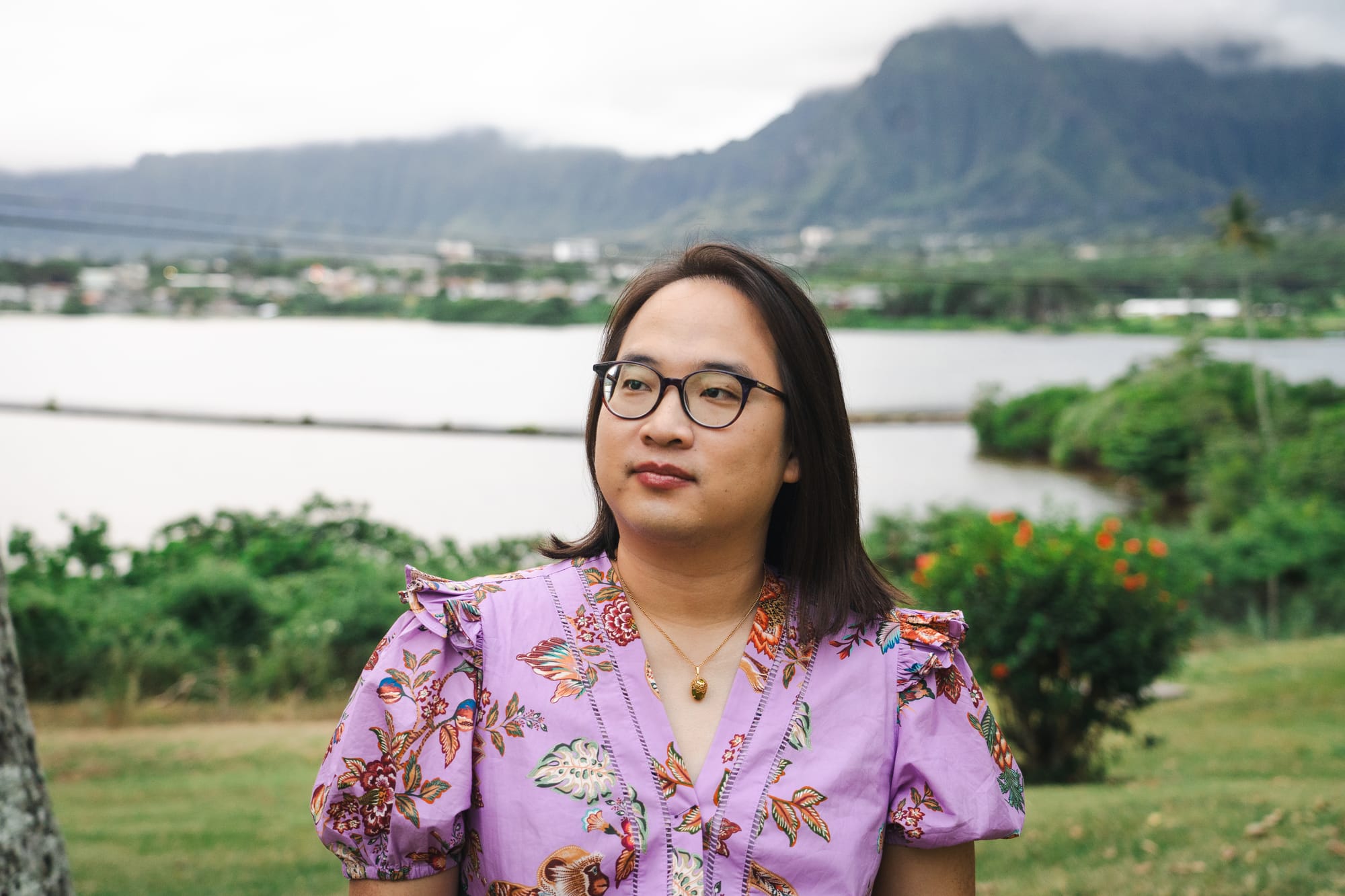
Keva X. Bui is an Assistant Professor of Asian American Studies and the Council for Race and Ethnic Studies at Northwestern University. They are a scholar of science, technology, war, and empire and hold a PhD in Ethnic Studies from the University of California, San Diego. Their research examines cultures of war in everyday life in the heart of U.S. empire, and how anti-war social movements offer visions of life beyond the stranglehold of the military-industrial complex. As a child of Vietnamese refugees who grew up in Taipei, Taiwan, their life has been touched by war on multiple registers. These intimate encounters with the US war machine guide both their scholarly research and political commitments to the work of demilitarization.
What about Asian American literature and culture inspires you?
When it comes to Asian American literature and culture, I’m inspired by its capacity for forging new worlds from conditions of violence and catastrophe and to reflect back onto the world that we live. As a scholar and researcher, I'm constantly stuck researching horrific violences—how war and empire have devastated communities, environments, and ultimately, people's lives. There's no singular Asian American literature or culture; it's not a monolithic category, but rather something that imagines and creates worlds—that is world-making and world-breaking. The central question that I think about is: How can we imagine better futures for ourselves and our communities?
I'm constantly inspired by how central art and culture was to the imagination of the Asian American anti-war movements of the 1960s and 1970s. A lot of poetry, a lot of political cartoons were circulated in radical newsletters during that moment that developed a very poignant critique of the military industrial complex. Those kinds of critiques offer us a pathway to organizing, to reflect on the world that we are trapped in and make use of narrative tools to unravel logics of violence. Literature and culture's capacity for shining a light on the world that we live in is so important to the work of demilitarization, and there's a lot of power in narrative to shape how we understand the world.
You said that you’re “constantly stuck” researching horrific violence—what makes this the case? Is there a link between that stuckness and the inspiration?
I think about that a lot, because I study weapons of mass destruction—things like napalm, herbicidal warfare, things that have caused horrific violence in our world. Obviously, it's not enjoyable work in a lot of ways, but I find it necessary; I do think we have to understand what led us to the violent conditions that we are mired within. How did we get here? How did weapons of mass destruction come to be normalized? There is a world before the military industrial complex—so how did this particular iteration of society become our norm? I think that's the tension between inspiration and stuckness that you're honing in on—that in order to be a scholar of demilitarization, to invest in anti-war social movements, I have to return to these violent moments to understand how they came to be. Reading the ways in which scientists and military commanders envisioned weapons—they envisioned this violence—sometimes it's so mundane how it's articulated in the archive, and it can be very jarring and painful to sit with those words and stories for long periods. But I also try to remind myself that it's in service of understanding the world, so we can build something better for our communities. To understand the anti-war movement means we have to understand the war machine that the anti-war movement opposed.
Was there an early moment that you became interested in these questions in particular?
I did my undergraduate training as an English major, and a lot of my early work was reading Asian American literature, particularly Vietnamese American literature. As the child of Vietnamese refugees, my entryway into Asian American studies was through personal and family experiences, thinking about, how did the Vietnam War affect my family's life and my own life? How is that structurally connected to a larger system of the U.S. empire?
And that led me to a specific interest in napalm; in Vietnamese American literature, napalm is a motif, a symbol, an idea that is constantly returned to. And oftentimes it would be this aside. It'd be mentioned. It would be a stand-in for something, a symbolic thing. For example, there was an interview that Ocean Vuong did with The Guardian where he talks about stories his grandmother would tell about the Vietnam War. He comments about how his grandmother would often mention napalm as an aside, such as “oh that came after the napalm,” but would never answer him when he would ask “what’s napalm?” I think there’s something significant about that exchange - napalm being omnipresent in these stories but lacking clear definition.
That interested me, so I began studying napalm’s history. The anti-war movement took up napalm as its iconic crime against humanity that the U.S. was committing in Vietnam. The infamous "napalm girl" photo that circulated in 1973 of Phan Thị Kim Phúc, for instance, catalyzed a lot of anti-war sentiments. But I also learned that napalm was developed during World War II and used in the Pacific Wars. It predates the atomic bomb. It was used in the Korean War. It was used in Israel's Six-Day War in 1967. For me, that posed a tension, in that napalm became this quintessential U.S. weapon used in Vietnam, but it stretches across all of these other histories of U.S. military intervention.
And so what makes it exceptional in the Vietnam War and normalized in other wars? Weapons are not just neutral objects, but themselves are bearers of political and cultural significance that shape the world that we live in. The tension between its symbolism and its material history is what sparked a lot of my interest in how cultural narratives around weapons of mass destruction are constructed, and then the work they do in consolidating the military industrial complex that we live in.
And what was your scholarly journey like, through Asian American Studies?
I was an English major at Dartmouth College, and then did my PhD in Ethnic Studies at UC San Diego. I learned about Asian American Studies when I was at Dartmouth in rural New Hampshire, an “elite” Ivy League university, very white, very isolated. There I met a group of Asian American activists who were organizing on campus to establish an Asian American Studies program. That's how I began my venture into the field. I took the very few Asian American studies classes that were offered on campus by professors who are no longer there. But it provided a moment for me to think about the political stakes of Asian American Studies as a scholarly field. It demonstrated how Asian American studies was something we as students had to fight for. It was knowledge and an intellectual community that we had to fight for. That's what granted it a lot of meaning for me, is how we had to fight for the space to even learn about Asian American history, Asian American culture, Asian American politics, Asian American social movements. Students of Asian American studies know that the field has a long history of student organizing, that it emerges from the Third World Liberation Front, the student strikes in 1968 at San Francisco State University and UC Berkeley that really established the field of Asian American studies and ethnic studies. I think that being in a place where it was something we had to fight for really was both a challenge but gave it, for me, higher stakes. And so I went on to do my PhD in ethnic studies and deepen my understanding. And so, living in San Diego, which is both a refugee city and a militarized city, it's very close to one of the largest military bases in the U.S., Camp Pendleton, and it houses a large refugee community of Southeast and also Southwest Asian refugees. Being at the Pacific borderland, as well as the U.S.-Mexico borderlands, creates this acute sense of living in a militarized city. Living there, doing a PhD in ethnic studies, really granted me a space of interrogating how, as I've mentioned before, war and militarization invades everyday life, because it was all around me. And at the same time, I began organizing with Vietnamese American communities in Southern California, with Viet Unity Southern California, the Hai Ba Trung School for organizing, and the Missing Piece project which is an artist-activist collective, and those organizations were important to my political development, especially how I think about the enduring impact of war on people's lives long after war “ends.” My scholarly study is informed by how I moved throughout society, and these political organizations; at the end of the day, I'm trying to understand how war invades our collective everyday life, and invades my own personal everyday life, how I constantly see war everywhere I move through the world.
In 2021, you wrote the article, “Objects of Warfare,” and then in 2022, “More Than Human,” then in 2023, “Eugenic Ecologies,” in 2024, “Napalm University,” and this year “Incendiary War,” a talk I heard you deliver at the AAAS conference. All are related to this subject; it seems to me that you've really allowed napalm to guide you in this very beautiful, ecological way. For you, napalm is coming out of diasporic Vietnamese cultural production in particular, yet also, when you spoke of napalm and white phosphorous at the conference this year, where people were grappling with the ongoing genocide of Palestinians alongside it being 50 years since the fall of Saigon, you seemed to be proposing a way for the materialities and symbols of empire to map this more expansive solidarity, wherein napalm was figured as a “sibling technology” alongside others. That was initially why your work stood out so much to me—how can we think through this ecology? What does it mean to draw this filial connection between technologies of genocide and war?
Thank you so much. That question really gets to the heart of what I'm trying to think about. This past year, we've seen Vietnamese American communities really grapple with how the anniversary occasions a moment to think about solidarity. But the tension is that the anniversaries connote an end that we have to commemorate as other violence is ongoing. What my research tries to articulate is that violence is not only ongoing, but it's recursive. There is this ongoing Nakba, almost two years since the most recent Israel bombardment of Gaza began, but a genocidal campaign that's been ongoing for decades since 1948. In 2012, the Human Rights Watch published an article about white phosphorus, and they declared it the “new napalm,” based on the U.S. usage of white phosphorus in Afghanistan, as well as Israel's usage in Gaza in 2009 as part of Operation Cast Lead. This is notable because white phosphorus was invented prior to napalm, during World War I, and was used as an incendiary device in wars ensuing after. Once napalm was invented, white phosphorus was used as an ignition substance within napalm bombs - napalm is a gelled petrochemical that can burn hot and stay hot, but needed white phosphorus to provide the initial spark. White phosphorus is a pyrophoric substance, meaning it catches fire upon contact with oxygen. So napalm and white phosphorus have always been used together. But what happens after the Vietnam War, is that because of napalm's iconography, napalm and other incendiary weapons were banned by the United Nations Convention on Certain Conventional Weapons treaty in 1980. White phosphorus is mostly unmentioned because it doesn't rise to the same cultural significance in terms of its iconography, so it goes unbanned. Then, it is continually used in the U.S. and Israel's wars in the years after. So my question about this sequence of events then is: what happens when we exceptionalize a weapon like napalm as exceptionally inhumane in comparison to other weapons of mass destruction? We risk inadvertently normalizing other technologies of violence, rather than saying, actually this entire structure of the military industrial complex needs to be abolished.
In this moment of the 50th anniversary, one of the things often unremarked about the radical anti-imperial, anti-war movements of the 1960s is that activists were making the claim that the U.S. was committing genocide in Vietnam. We're in a moment where there is a lot of debate over the term genocide. Who gets to claim the term genocide? But actually, the exceptionalization of the term obscures the ongoing structural conditions of violence that imperial nation-states continue to wage on colonized peoples. I draw a lot of inspiration from the 1951 Black Civil Rights Congress petition to the United Nations, “We Charge Genocide,” where a group of Black activists, three years after the UN Genocide Convention, which established the terms of genocide after the Holocaust, charged the U.S. with committing an ongoing genocide of Black Americans, dating through slavery, Jim Crow laws, lynchings, and all of these other forms of structural elimination. What this moment exposes is that if we allow genocide to be taken up at its full definition, then the U.S. would be culpable for all of these other imperial violences, from its ongoing structural racism against Black communities to its military interventions in Korea, in Vietnam, later in Iraq and Afghanistan, as well as its support of Israel's genocide in Gaza and Palestine more broadly. These are questions to think about. Not to say it is or isn't genocide, but that the language offers a framework for understanding why the exceptionalization of the term obscures our capacity to understand how violence is connected in these expansive ways—not only in a way of analogy, like that Israel's genocide in Gaza is similar to the U.S.'s military intervention in Vietnam, but actually with material connections in the technologies that are created, used, and exchanged, and the ways in which those technologies enable new innovations across these joint military-industrial complexes to thrive. The severing of our capacity to recognize and map those connections across different moments of violence, is what leads us to think of war as an event rather than a structure, a one-time thing rather than a continuous structure of violence that we are living in.
That has to do with where you began—with forging new worlds, right? In and against the continuous violence of the world we live in now? How can we understand the structure of the current world?
Yeah. The world we live in is one of constant and permanent normalized war. People have this idea that war is a natural condition of human life, and I fundamentally disagree. War is manufactured, especially the way in which we articulate war in our current age. Contemporary war is completely different from pre-modern war, where you have clearly defined nations with clearly defined militaries engaging in combat on a battlefield. Now, war is very deeply seeped in everyday life. It's in our institutions. It's in our universities. It’s in our homes. It’s in our businesses, industries, corporations. People don't think of corporations like Google as a defense contractor, or a war company, but as recent campaigns like No Tech for Apartheid have demonstrated, Google has extensive contracts with the Israeli defense forces. And this is something that partially emerges in the aftermath of World War II, in the aftermath of the atomic bombings of Hiroshima and Nagasaki, where U.S. politicians and scientists were able to point to the “success” of the atomic bomb, of the Manhattan Project, as this collaboration between the military, the government, and scientists, and say, this is good for national security. And they consolidated that as the way in which we live. That's why we have the ballooning of defense contracts for the military and government funding for U.S. universities to conduct research that, whether directly or implicitly, aids the U.S. war machine. That's part of how the U.S. university expands in the post-World War II moment.
So I think about this often—how do I reconcile my place in the academy with the immense entanglement that the university has with the military industrial complex? But at the same time, as I write about in my article in “Napalm’s University,” the university has also been a really important site of the anti-war movement, where students have been able to find intellectual, political community that radicalizes them into these kinds of organized anti-war movements. The 1960s was this early moment of both, and the sit-ins, encampments, and protests are reemerging in our current moment, as that relationship between the university and the military has only deepened. People get the sense that this is how it's always been, and therefore will always be, but if we understand that there is a history to this, that gives us a pathway to imagine otherwise, and to understand that this isn't a normal condition of intellectual life at the university, nor a normal condition of life. It can be contested. It can be abolished.
One of the differences between contemporary and pre-modern war is the invention and use of the weapons of mass destruction that you research—not only napalm and tear gas, but also herbicidal weapons like Agent Orange. Alongside the “genocidal,” I keep returning to “herbicidal” as a category that gestures towards the eradication, as you wrote, of an “ecologically-porous definition of enemy life”—the exceptionalism you discussed is also deployed in terms of the human, so I’m curious if you could tell us more about how the U.S. war machine involves and affects not just people, but plant matter, land and ecology.
Definitely. When I write about herbicidal warfare, I'm particularly thinking about the history of Agent Orange, which is a chemical defoliant that was used in the Vietnam War to eliminate mangrove cover as well as cropland in rural and jungle areas of Vietnam. So part of the idea behind the chemical defoliant is that it could remove the plant cover that guerrilla fighters were supposedly hiding beneath and would become visible to U.S. fighter jets flying above. It was the idea that if you can remove the ecological life that the insurgents were embedded in, you could better fight the war. So war became a battle over control of land and terrain.
Arthur Galston, who was a plant biologist, coined the term “ecocide” to refer to the destruction of the environment as part of military intervention. One thing we sometimes talk about is that the U.S. military is the number one polluter in the world, and the number one contributor to carbon emissions through ecocidal campaigns like in Vietnam, as well as the emissions produced by millions of fighter jets, hundreds of military bases. So it's important to put that ecological devastation alongside the obvious human devastation of it. What is happening in the shift from pre-modern war to the modern military industrial complex, is that all of society, technology, infrastructure, and resources are geared towards the inevitability of war and extracted from communities. The increasing cost of health care, housing, education, child care, the lack of resources for communities of color, low-income communities, those are all structural because they are resources taken from those communities to funnel into the war machine. War is ending our world in many ways, in terms of how it conditions us to think, and how it is ending human life, and how it is shortening the lifespan of our planet through ecocidal campaigns of violence and the destruction of our environment, and these are all entangled in terms of how the military industrial complex has this cascading effect on more-than human life across the globe that we will feel for generations to come.
You earlier mentioned the photograph of Phan Thị Kim Phúc, but in addition to images, you also write about novels and performance. Do you see these forms working differently in relation to fighting imperial violence? Perhaps emerging more prominently from your work is a sense of the solidarity and insights of a coalition of artists across different mediums intervening in the world as is and forging new worlds.
It’s a big question that I'm still grappling with, because I think there's something intangible about what inspires us about art and culture. You know, sometimes we are moved by a particular piece, and only years later do we really identify why. Sometimes it's immediate. Sometimes we're like, oh, I know why. But I think that for me, part of it is its capacity to intervene into the world and make other stories visible and possible. A film that I watched recently that left a deep impact on me was “We Were the Scenery” produced and directed by Cathy Linh Che, Jess X. Snow, and Christopher Radcliffe. The film is about Cathy's parents, who were part of a group of Vietnamese refugees in a refugee camp in the Philippines recruited to be extras on the film “Apocalypse Now,” which is a very infamous, iconic Vietnam War film. The film centers on their experiences as background extras in the infamous napalm scene in “Apocalypse Now,” where a fleet of U.S. fighter jets drop tons of napalm bombs during the war in the backdrop, and in the foreground a colonel proclaims, “I love the smell of napalm in the morning.” This very militarized and masculinist portrayal of fascination with the violence of napalm has become an iconic and infamous depiction of the war. But “We Were the Scenery” uses that moment as a way to center the background actors and their experiences of how they made life in the refugee camps. What the film does is it takes this iconic moment of violence and turns it around to tell another story about it, that is hidden beneath, that is literally lurking in the blurred background of this soldier speaking about his fantasies of violence. What is in the background is people's stories of refuge that allows us to think, what lurks in the background of political and military violence? How can we use those stories to propel us to think about these larger questions about Vietnamese refugee communities, the military industrial complex, and the way in which military propaganda shapes how people orient themselves to war? It allows us to start asking questions about what we take for granted in the world. And in asking those questions, it gives us space to imagine other kinds of ways of being.
Do you think, when it comes to narratives told about Asian American history or in Asian American Studies, war and the military-industrial complex are too often also lurking in the background?
I don’t think that’s the case, actually. I think Asian American studies has been an important field for engaging counternarratives to war and militarism - both with its inception in the anti-war movements of the 1960s as well as really brilliant contemporary scholarship. My work would not be possible without this work coming to be—I am really inspired by the work that Asian American Studies and more broadly, Ethnic Studies scholars have been doing to ask critical questions about the military industrial complex and the war society that we live in. From scholars of the Cold War and Vietnam War to people critically analyzing the contemporary war on terror, anti-war scholars across the field are making really important connections that we need to grapple with. Anti-war scholarship is integral to the work that we're doing and how it can align itself with anti-war movements, both past and present. How do these visions for a world without war drive the kind of scholarship that we do? That driving impetus is important. I do think that we’re moving in a direction that will continually grapple with the multidimensionality of war. That’s what I'm really grateful to see, that we're grappling with the multidimensionality of war.
Who are the scholars who inspire you in this respect?
There’s far too many to name, because there are so many great anti-militarist scholars out there doing incredible work. Jodi Kim’s book Ends of Empire, published in 2010, was an important moment in the field for giving us a framework for understanding the Cold War as a structure, not an event. It helped establish a vocabulary for analyzing Asian American cultural production in the aftermath of the Cold War as a vector for understanding the racializing dimension of the war, and I think that opened up a lot of different modes of inquiry for understanding war in our everyday lives. Asian Americanist scholarship on war and militarism is extremely rich, and I’ve learned so much from the work of Simeon Man, Christine Hong, Yen Le Espiritu, Thuy Linh Nguyen Tu, and so many more.
I have also learned a lot from my former colleagues at the University of Illinois - Junaid Rana, Mimi Thi Nguyen, Rachel Kuo, and Maryam Kashani who have all really helped me situate a lot of this scholarship on war and militarism within our present conditions of ongoing genocide and violence. And I also have a lot of collaborators and co-thinkers around the intersections of war, science, and technology whom I’m constantly learning from, scholars like Natalia Duong, Aimee Bahng, and Heidi Amin-Hong. And finally, I’d also like to give a quick mention to the Mundane Militarisms collective, which emerged out of one of Sunny Xiang’s graduate student seminars at Yale University. I use this resource all the time in teaching, to show students how war lurks in the background of our everyday life so seamlessly and invisibly. This model of scholarly inquiry is so important in our day and age, as we try to make connections that are not always otherwise apparent.
Your attention to inquiry as a mode, even unconscious mode, is really striking in your work. For instance, you wrote about the deep imperial logic embedded in the asking of this question, “How can we make war more humane?” I’m curious, what better questions can we dwell with? Is it, how can we demilitarize? How can we forge new worlds?
Yeah, that question is one, as I write, that imperial militaries and nation-states like to proffer—how can we make war more humane, how can we innovate more precise technologies? Currently, we see the increasing usage of AI targeting in military campaigns to “lessen” collateral damage, and so technology is proffered as offering the potential to make war more humane by “only” eliminating “terrorists” and leaving “civilians” unharmed. But these are all constructed categories, and how they are defined and employed is very much deeply racialized in our current moment of the war on terror. And it also explicitly and implicitly ignores the very stark reality that war, in requiring the elimination of human life, is by nature inhumane. And if we move from that premise, then the question of how to make war more humane becomes obsolete precisely within asymmetrical conditions of imperial warfare and the structural conditions of racism that lead to it in the first place. The question more broadly we could ask is, how do we make society more humane?
And that would necessitate the elimination of war altogether, the absolute abolition of the military industrial complex that exists to maintain a particular status quo of imperial power, and the prioritizing of human life, environmental life, ecological life, planetary life, and the relations that sustain us.
I’m also wondering about the structure of war in relation to a word like “peace.” There’s this injunction often used against war consciousness, “keep the peace.” I want to understand what undergirds such a phrase, and “peace” in relation to other terms, “liberation,” “revolution,” and “utopias” that may be impossible to fully imagine or define. What are the terms that sit together with, or are dialectically related to, the structure of war?
That's a good question, because I’ve always had conflicting feelings about the word “peace.” It is very much set up in this dichotomous relationship to war as an event - a singular moment in time. If we are not at war, then we are at peace. It is a language that was used in the post-World War II moment to say that times of peace are moments where all segments of society need to be preparing for war, for national security and future war. The sentiment is echoed in scientific advisor Vannevar Bush's document, “Science, The Endless Frontier.” This idea of peace is not necessarily the antithesis of war, but envisioned as a momentary pause, a ceasefire, in a perpetual condition of war. That's why peace can make me feel uneasy, because it is captured in a colonial imperial imaginary rather than an actual break, a break from the condition of a permanent world that we see as inevitable. That’s why I constantly return to the language of abolition and what abolition looks like. Of course, this is very much indebted to prison abolitionists who are imagining a world without police and prisons. Abolition gives us the language and framework to think about demilitarization more wholesale, that doesn't mean imperial nation-states putting down their arms and not fighting in a momentary pause from a permanent condition of violence. The end of war requires a radical reorganization of society, from the economy to industry to education, because society's resources are almost fully oriented towards continual and perpetual war.
Earlier, you said you see war everywhere you go, and I’m curious where you're calling in from, and where you grew up—in these places, how have you seen war in your daily life?
I’m calling in from Seattle right now, it's where my parents live, but not where I grew up. I was born in Texas, first in Houston, then Austin, and then when I was about 10, I moved to Taipei, Taiwan. There, I attended Taipei American School, an institution originally founded by missionaries on the island who sought an “American” education for their children and the children of US military personnel stationed in Taiwan during the Cold War after the Kuomintang political party fled there. Not a lot of people at the school acknowledge this history or think critically about it, but in my years after leaving high school I often think about what it means for my education to have been routed through a circuit of US militarism - how military occupation laid the foundation for “softer” forms of US influence on the island that persist to this day even in the absence of “formal” US occupation. How did war shape what my education came to be? How does war lurk in the background of my own life, and how is my schooling fundamentally a product of violent war and Indigenous dispossession? These seem like large questions, yet they are relevant to us no matter where we grow up or live - precisely because the US war machine lurks everywhere. And part of my work is trying to think more deeply about these conditions.
Our personal lives are very much inflected by war. My parents came to the U.S. as a result of U.S. military intervention in Vietnam. That is what led to their movement from Vietnam to Texas. And then it was my dad's job in the tech industry that relocated our family to Taipei, Taiwan. This is a perfect example of how two transnational circuits - one of militarized refuge and another of global capitalism - move people across the world but still connected to the web of U.S. empire. These histories of war and mobility have fundamentally shaped my life and also the different privileges I was able to hold, attending an international school somewhere like Taiwan and the kinds of experiences and education I received as a result. War and militarization create these kinds of cascading experiences in how they invade everyday life. War brings about our world in particular ways.
What about Chicago, where you live most of the year?
Chicago is—I mean, as everyone knows, a heavily policed city. The technologies of policing that are present in Chicago are very much militarized and about tracking the movement of certain populations—particularly for Black, Brown, and immigrant communities. At this very moment, we are witnessing ICE terrorizing our streets and invading our communities - this notion that “inner cities” are an important frontier of war is governing the regime of state violence against communities of color. So when we talk about war as a condition of our everyday life, it's not just about the battlefield, but it's the ways in which technologies of war and militarization are mobilized to police the movement of populations, as well as the increasing dimensions of immigration detention, the deployment of ICE, and the increasing ballooning budgets of ICE to identify the “enemy” and remove them from the country. At the end of the day, this is the prevailing racial logic of war: to identify an “enemy” for elimination. These practices are inherently violent and enabled by these increasing surveillance technologies that are products, particularly of the post-9-11 movement, of the Department of Homeland Security, and Immigration and Naturalization Services, the creation of ICE. We think these dimensions of society are normal, but are actually emergent in the post 9-11 moment of particularly acute Islamophobia and the policing of black and brown Muslim communities. It's war on the home front, as scholars of the war on terror constantly remind us. But Chicago is also a city with vibrant political movements, both historically and also in the present that have and continue to challenge this regime of oppression.
Seeing war everywhere, does that feel like a weighty experience? How do you hold and move with or through that?
It’s both weighty and I think we bear a responsibility to make it weighty, if that makes sense. War is so normalized in our everyday life, it lurks in the background in ways that most people don’t even notice its omnipresence. To make it weighty - to pause, reflect, comment, and challenge - is the work of untangling this constant presence that invisibly but indelibly shapes our movement through the world. And I think this is a crucial part of the work of demilitarization, to make visible what previously isn’t and to assert that war is not a normal condition of everyday life. And once that becomes our motivating thought, once that becomes our political compass, that gives us space to imagine something anew.
One thing I admire, during this interview, and in your writing, is the emphaticness of your sentences. I'm thinking of the way you closed “Incendiary War,” you said, “If napalm and white phosphorus are deemed exceptional, then that narrative only serves to inadvertently reaffirm a liberal narrative that there even exists an ethical, humane method for an imperialist nation state to wage asymmetrical wars against colonized others. I emphatically assert that there is not.” And then, rowdy applause throughout the conference hall. It feels like there's so much journey and substance behind or anteceding that emphaticness. It’s everything we’ve been talking about this past hour, but my last question is just—what is it like to arrive at this kind of emphatic sentence or emphatic voice? Where does it come from, how does one develop that kind of emphaticness?
My goal as a researcher and a scholar is to communicate my argument convincingly to an audience, and it always starts with the premise that it's emphatic, because my belief is emphatic. My belief in a world beyond war is emphatic. So I want to communicate that through with emphasis, a confidence in our ideas, but also not just confidence, a steadfast belief that this is possible, that a world without war is possible. The emphaticness that you are ascribing to my work is really a product that I want my work to offer a pathway into believing that something is possible. That is the first step to really envisioning these other worlds, is to actually believe it is possible to live in a world without war and then to find ways to bring that into being—through craft, through language that is about communicating the possibility to believe it is possible. That's one of the things that I strive to do in my writing, in my scholarship, is to leave no doubt that I do believe in this and that I believe that we can actually enact this world.
Winona Guo is a PhD student of Asian American literature at Columbia University, and author of Tell Me Who You Are (2019).
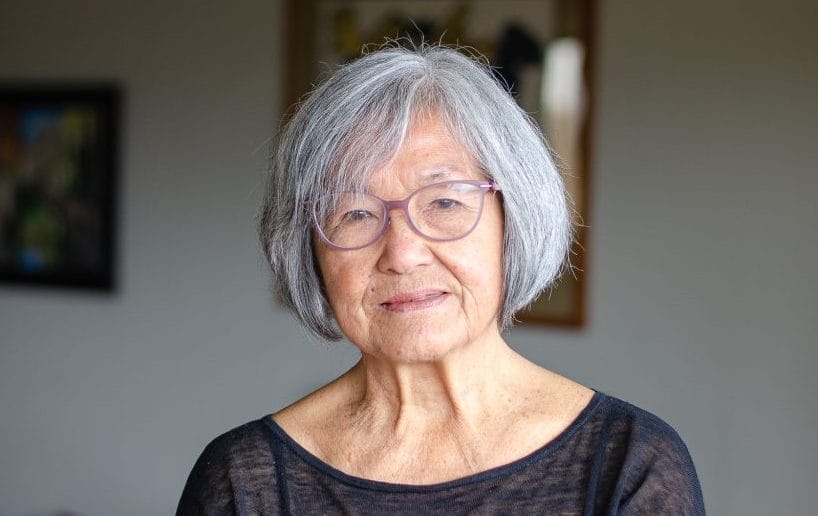
Nellie Wong is a poet and activist living in San Francisco. She is the author of five collections of poetry that span from 1977 with the publication of Dreams of Harrison Railroad Park to her most recent collection, Nothing Like Freedom (2024). Wong co-founded and organized several feminist literary collectives, including Unbound Feet (with Kitty Tsui, Merle Woo, Nancy Hom, Genny Lim, and Canyon Sam) and The Last Hoisan Poets (with Genny Lim and Flo Oy Wong). A socialist and a feminist, Wong is also a longtime member of revolutionary socialist organizations, Radical Women and the Freedom Socialist Party.
I first learned about Nellie Wong at a poetry event in 2019, when, during a Q&A, an older poet lamented how no one seemed to know Nellie’s work. A poet from an earlier generation, Nellie seemed to be at risk of being forgotten, as Asian American poetry becameomes an increasingly prestigious and acclaimed body of work in the 21st century.
I was one of those uninitiated, so I began to do some research: I bought a used copy of The Death of Long Steam Lady, ordered a DVD of Mitsuye & Nellie, Asian American Poets, and learned what I could about her life as a poet, an organizer, a feminist, and a secretary. All of these roles—poet, feminist, worker—came together in what I would describe as a poetry of lifelong commitment: to living a Third World, feminist, and socialist life, and to writing a form of poetry brought all these identities together.
I met Nellie in January 2023, where she generously invited me into her San Francisco home for an interview. Over hot tea, I spoke with Nellie about how she became a poet and an activist. A few months later, over Zoom, I spoke with Nellie again to continue our conversation about her political development through her involvement with socialist feminist organizations. We also talked about her close comradeship with other Asian American poets-activists like Kitty Tsui and Merle Woo, and her 1983 trip to China with Tillie Olsen.
Tell me how you got into writing poetry. What drew you into poetry in the first place?
I was working already. I'd been a secretary, an administrative assistant, and an affirmative action analyst when I was working. I went to San Francisco State in the early 1970s, after I’d already worked many years. What got me to go to college finally were a couple of things. My younger sister, Flo [Oy Wong], an artist and poet, said that I should take up writing. I asked, “Why”? She said, “Because you’re kind of funny.” [laughs] “Your newsletters are really funny. You should take up writing.” In those days, we didn’t have computers or phones, so I would write to my siblings to tell them to bring this or that for Thanksgiving or Chinese New Years.
Flo also said, “you also watch too much TV. You should get off your butt.” [chuckles] “Okay,” I thought, “Maybe I will do that.”
I signed up for a class at Oakland Adult Evening School. It was on short story writing. The teacher liked what I did, and every week I would raise my hand, I would have something to say, and I was writing. One of the first things I wrote was about my father. I think I wrote it as a parable. At that time, I didn't even know what a parable was. [chuckles] Each week I would write and turn in something. The other students were all adults, and it was only five blocks from where I lived in Oakland.
I was also working at Bethlehem Steel at the time. At work, there was an educational assistance program. The education assistance program was there to help us to do our jobs better at Bethlehem Steel. So I signed up, and my supervisor okayed all the courses I signed up for. I signed up for Asian American Studies. I signed up for Feminist Studies. I signed up for Creative Writing and English Literature. Here I was, already in my early 30s, and the classes that I took, I could only take at night because I worked full-time. That's what got me started.
I also signed up for a poetry class. I was very naïve, and I thought, "I'm interested in what poetry is. I don't know anything about it. So I'm going to sign up for this class.” But then, I found out it wasn't to study other poets. It was to write poetry. I was too scared at that time to drop out, because I’d worked so long to get to college. On the first day, the professor said, “People with last names between A and D are going to read next week.” I said, “Read? Read what?” [laughs]. We were supposed to read our own writing! I’d never written anything.
So I wrote. I was married at that point, and living in an apartment in San Francisco. I told my then-husband, "Leave me alone. I'm going to write a poem." [laughs] That's how I got started. I wrote some poems, and I took one to class the following week. My married name was Balch, B-A-L-C-H, so I was one of the first student poets to read. I read one on Miss Chinatown, USA. It’s called “Drums, Gongs.” It was in my first book, and eventually published in East/West [Chinese American Journal], an English language newspaper that came out of SF Chinatown.
After I read, the teacher said, “Once you've written angry poems, you should throw them away.” I was just mortified. I wasn't speaking up in those days. I told some other students in my feminist studies classes, and they said, "You don't have to listen to him.” I was just shocked. "What? He's the professor!" Eventually, I showed them my poetry, and then I joined their group at SF State and started getting active and fighting for the inclusion of women and people of color in creative writing and other classes at SF State. I got active, and I joined the creative writing caucus. That's how I got started. I'm glad I mentioned it to my fellow students in the feminist studies classes. A couple of them were social feminists, and that's also how I met the Freedom Socialist Party and Radical Women at that time.
Your work at Bethlehem Steel, of course, makes it into your poetry. Tell me about how those things came together.
It started with my late friend and comrade, Karen [Brodine]. She's one of the women I met in my feminist studies classes. We did a workshop in the creative writing caucus, and she said to me, “You have to write about work.” I asked, “Why? I'm only a secretary.” "Nellie,” she insisted, “You have to write about work." That started it.
I found I had a lot of stories, and the poems started to come out, poems I didn't know were there. I think some of my best pieces are related to my life as a worker, as a woman worker, and being Chinese and a woman of color. Because there was so much racism and sexism that I encountered throughout my whole working life. What was really exciting is that there were all these possibilities opening up for becoming a writer, becoming a poet, that I didn't know [were available to me].
And then how did you get involved with Radical Women and the Freedom Socialist Party?
Well, that was Karen [Brodine] and another person, Sukey [Wolf]—they were in my feminist studies courses. We got to know each other through the creative writing caucus, and we had started organizing. They were recruiting me, but I didn't know that at the time. I started reading Marx and Engels, and I was invited to go to a meeting that the Freedom Socialist Party and Radical Women, their sister organization, were organizing. On the agenda, I remember, was the subject of divorce. I thought, "What in the hell does that have to do with the left and politics, and such?" That really got me going, thinking about it. Because I was divorced-- no, I wasn't yet, I was still married.
That was really kind of a kick in the butt to me, and I started understanding and reading more. The reading, the writing, and the activism all started to come together where again, my consciousness—I realized I didn't know a lot of stuff. That is how that all came about, and I began to look at my life as a working person. A lot of what I wrote, I wasn't really aware of what was coming out. I just wrote what I was going through. Do you know my poem, “Toss Up”?
You call meinto the hall. Standard procedurefor a conference.
You ask me:
if we had a fight, whose side would you be on?
His because he is Chinese, or mine because I am a woman?
That came from an actual experience with a supervisor who said that to me. Of course, that's one poem that I’ve memorized because it's short enough.
Actually, it was several years before I decided that that's what I wanted to do: to be an activist. All the ideas of socialism, Marxism, and the ideas of feminism—all those were a part of entering my body and my brain. That's what happened.
The topic [of the meeting] also had focused on the late Clara Fraser. She started the Freedom Socialist Party along with some others, when the party broke away from the Socialist Workers Party. Some of the issues were on feminism, on China, on the woman question, as we talk about it in socialist politics. That became a real draw for me and really excited me. I thought, “Maybe I shouldn't just be writing about family, being Chinese American, and being a working woman, et cetera.” That all started to enter into my life with what I wanted to do as a writer. Although I still have never really said, "Oh, you're a writer. You're a poet.” I always think about, "If I say all those things, then there would be too many expectations for me to fulfill those ideas or positions." That's when I began.
When I joined the Freedom Social Party, I was just really thinking about how I could contribute to making change, and what kind of a society we live in when we have racism, sexism, and class oppression. It all started to gel for me as a place where I wanted to be and where I wanted to work.
Now, as an older or a more mature person, [chuckles] hopefully, there was more to poetry than just expressing myself. There was a connection to other people of color, to women, to family, whether chosen or not. Those kinds of issues all came up for me. I would say that was what really kicked everything off. Then, of course, my husband was very angry that I was becoming radicalized and socialized, though he appreciated my publishing and getting a few poems out.
What were some things you were reading or encountering at that time that motivated you to embrace socialism and feminism?
It was really looking at the conditions of women. Radical Women is an organization that still exists and is a sister organization of the FSP. Reading The Radical Women Manifesto was very instrumental in helping me to think more and to understand historical materialism. I began to learn how these concepts connected to my own life, the life of my communities from which I have come.
Since I was a feminist, I thought I was unusual, because in the classes at SF State, there weren’t a lot of people of color or women of color. I got very excited when an instructor in Women's Studies introduced a new anthology that came out that had the writings of women of color. Many of them were radical women of color, some of them were lesbian. But there was all this social and political context in their works.
I was very excited and at that time, I still saw myself as a beginning poet and writer. But I still thought, "How come I'm not in that book?" [laughs] I just didn't know why that seemed really important to me, but I also was looking for stories, poetry, and essays on people of color, women, and feminism.
When I began to read a lot of these books and booklets on feminism and socialism, it really began to make sense to me. I'm just not living and growing up as a personal person. [chuckles] I began to develop an understanding of dialectical materialism and how it relates to me and what I was doing. I began to understand all these wars, like what World War II was about, or what happened in the Vietnam War, which got me thinking about the social and political aspects of life that were connected to the personal. Why did I always think that my life was my life, and if something didn't happen, it was my fault? Or if something did happen, I'm somehow responsible? I wasn’t understanding those connections, living as a human being.
One of my experiences as I was beginning to learn through books and activism—there was a bookstore in San Francisco's Chinatown or Manilatown area. I think it was called China Books. I was so curious, I used to go in there and start looking at books. I started talking with one of the owners, and I was interested in what happened with China, because my parents were from China. The China they came from was a small village in Guangzhou or in Canton. I was totally curious and interested, so I began to go to that store and pick up some books.
At that time, I didn't understand what Maoism was, I didn't understand Trotskyism or Stalinism. Freedom Socialist Party also had a lot of documents and books and publications that I began to read and absorb. But I think the key was feminism. That drew me to the Freedom Socialist Party and Radical Women. We were all women who are a little bit older. Not in their late teens or early 20s, but in their 30s and 40s and up. That was something that drew us together, as well as ethnic studies, or women's studies, or LGBTQ [issues] and labor and such.
I already mentioned that Karen encouraged me to write about work. That was another opening when I began to see. I didn't know what class was at all and so those were part of what I see as my stepping stones into joining and being active. I changed personally, and it was because of the political that I was able to read, understand, examine, analyze, and question everything.
You were most active with FSP in the '80s and '90s. Looking back at those years, a lot of people would characterize them as counter-revolutionary or reactionary times after the Civil Rights Movement. What were some of the struggles you and FSP faced?
For me, I love what we were able to do. It's not like everything is a victory, because it's not easy being a revolutionary feminist, let alone a revolutionary feminist of color. [chuckles] Not to mention being a little older. Because you're going against the current. If I keep on writing and if something gets produced or published, that's of course not the end-all be-all.
But I also see writing as activism. What kind of a country do we really have? Is this the kind of United States that we really want to build? I want to be a part of that change if I can. My work is related so much to seeing the possibilities of a changing world, that we need to build for a society that does not chase after profits or money for military and arms manufacturers.
The whole concept of leadership is a part of what we work on and think about. What is a leader and who is the leader? I can't explain it all in our interview, but leadership is a relationship. Leadership comes with what we think we can do, and the vision that we have for building a society that would eliminate so many of the things if money, profits, and domination weren’t a priority.
I've also been baited for being a red or sticking with the FSP. One time, a friend of mine told me, “Clara Fraser is a racist." I said, "What?" This friend of mine, she was a co-worker at the time, and I said, "You think I would join a movement or an organization that was racist?" She couldn't answer me, and I thought, "Now why would she think Clara was a racist?"
She obviously didn't know the work of Clara Fraser, who's a Jew, whose parents were socialists and union organizers. There are a lot of battles we have to fight, just because we're of the left. Other times when people say, "Oh, you shouldn't join that organization," or, “you should stay away from those women because of what they're doing." I would say, "you know what? I'm one of them."
Then the conversation doesn't go further, because of a lack of time or whatever the circumstances are. Or there's little respect you have of me, because I'm doing something different from what you're doing and what you're thinking. It's about being open, if you can be, to the ideas, to the vision, to the work, and to our global reality.
Even on the left, among socialist groups, we have a lot of differences. But as Trotskyists, we talk about the need for a united front, where we can join and work together. We can raise our own banners, but we have to understand that we share a goal of what we want this movement to be. What are our possibilities, when the neo-fascists come riding into town, or the anti-abortionists come into San Francisco every January? Usually, those who are protesting are small in numbers. There's also a larger question of how the left has to organize. So that's part of what I'm trying to do as a member and activist within the FSP.
I want to go through some of your friendships and collaborations with other Asian American poets as well. We can start with Merle Woo. How did you meet Merle?
Well, I was going to SF State at the time, and I was in a class. Then I had a friend in the class who was taking Merle's class. She was teaching at SF State, and I didn't know her. Because I was only going to school at night, I said, "Oh, I can't take it.” But she was doing a class on Asian American women. I said to my friend Mimi, "Why don't you find out from Merle Woo if I could talk with her or meet her? Because I can't take the class."
Well, then she brought back a tiny piece of paper, and it had Merle's phone number on it. I called her, and that's what started our friendship and we started collaborating a lot. Then I was in the Women's Caucus in Creative Writing at that time, which became the Women Writers Union at SF State. I introduced her to the caucus, and she met Karen and we all started to do stuff together.
The first time I met Merle was at a reading for my first book. It was Dreams in Harrison Railroad Park. She came with a fellow teacher of hers. I think she also brought her son, Paul, who was only 11. Anyway, we met and that's when I met her. That's how we started our friendship. Then I introduced her to what became the Women Writers’ Union, and she joined it.
We were two women of color, two Asian American women that were the only—No, there was a Black woman. There was a Black woman also involved, but all the other women were white. Many were lesbians, and Merle is a lesbian. It was just fascinating, the encouragement and the push came from women who were radical and women who were gay.
You've also collaborated a lot with Mitsuye Yamada.
Have you seen the film, Mitsuye and Nellie, Asian American Poets?
Yes, I have.
Oh, good. I'm glad you saw it. That's also connected to SF State. Allie Light [the director] was a teacher. Allie is actually a neighbor of mine. She lives right here in Glen Park. She and her husband [Irving Saraf] were filmmakers. Allie was teaching a class called the Woman as Creative Agent. When I saw the class, I said, "I'm signing up for that." She and this other woman taught the class. That was one of the most exciting things I've ever gone through. We learned to write in dream journals and such…
Allie knew Mitsu. I didn't know Mitsu at that time. I had heard of her, but I didn't really know her. I knew what she had written, and I had gotten her book, Camp Notes. To cut to the chase, Allie talked to both Mitsu and me, and she said, "I'm going to make a film, and I want you guys to be in it." She knew us older Asian American women who were poets and who were feminists. What pushed her towards that was that there was a film festival going on in SF State, and there were films on Black women and white women, but none on Latinos or Latinx, nor on Asian American women. She evidently got the bug from that. I thought, "Okay, I'm going to be in a movie." [laughs]
She didn't really write a script, but she submitted an application for the National Endowment for the Arts. Even before she got the grant, she started filming us. I was living with my then-husband in Oakland in a Victorian that his grandfather built. She started filming me there. That's how the film got started. Then she got the grant, then we went to--which camp was it? Because of Mitsuye’s experiences from the concentration camp when the Japanese Americans were sent to the camps after the bombing of Pearl Harbor.
What do you remember about the very first time meeting Mitsuye?
Our filming experience together, and the fact that I really liked what she did in her writing—I think that there was that connection. She and her brother, Mike [Yasutake], in particular who was a priest—they were activists and supporting political prisoners, particularly the African American men who were imprisoned. I was getting another opening to what was going on with people of color, and that was all through Mitsu. You know, she's 99 now, I just received a Christmas note from her. We talk now and then, usually through email or a text, but we still have that connection. The filming really brought us together so much closer.
And how did you meet Kitty Tsui?
We formed Unbound Feet, which consisted of Kitty, Canyon Sam, Merle Woo, Nancy Hom, me, Genny Lim. I never knew who started it exactly, but I think we found each other through the community, the movements, and feminism was a strong part of that. We were together for about a year and a half, two years. It wasn't very long, from the late '70s to the early '80s.
What did you do together?
We wrote, and then we shared our writings. We didn't do workshops—well, maybe we did with each other. Then we said, “We have to read this to the community, we want to read our work.” Nancy Hom did this poster, and we did a performance. She's a great graphic artist, a community artist, so this is how we started. That's how I met Kitty and then I got to know Nancy, and that's when I really got to know Genny, Merle, and Canyon as well.
Do you know of a poet by the name of Stella Nanying Wong? She was a little older. She was very well known in the Chinese American community. When we started though, she wasn't a part of the group. We actually started with Stella, but we weren't Unbound Feet yet. We were just getting together to share our writings and to perform.
Most of us in Unbound Feet were either Cantonese-speaking or Taishanese-speaking. I’m part of the Last Hoisan Poets, with Genny and my sister Flo. Kitty is Cantonese, she's not Hoisan speaking. Her background is really fascinating. Her grandmother was an opera star. I think she even said that her grandmother was a lesbian, because they never really talked about it. That was just really fascinating. Anyways, that's how Kitty and I worked together for a couple years.
In 1983, you went on a trip to China, the US Women Writers Tour to China. It was right around the time where China was reopening again—
Yes, because China reopened after Nixon in the ‘70s. You want to hear about how I got into that? Sometimes it's just by chance and by luck.
I knew Tillie Olsen. I think she liked my writing and knew of me, although I didn't really know her well. One day, she called me up. I was already divorced then, and I was living alone. She called me and said, “Nellie, there's going to be a trip to China with the US-China Peoples Friendship Association, and there are no Asian American or Chinese American women on this trip. Can you come?”
The trip was in 1983, so in 1982, I was still working at Bethlehem Steel. However, we had already been notified that Bethlehem Steel was shutting down. I knew I would be out of a job at the end of December. When Tillie sent that, my first book was out, and that's all I had. I used my severance pay to finance my trip.
That's what happened there. I was delighted that Tillie called and asked me to go. I said, “Wow, I'll try to go to my father's village,” which I did. [laughs] By luck, I got to go to my dad's village in Guangzhou. It was in the Taishan area around the Pearl River Delta. Our village was the Taishan-speaking village.
What was that like for you, visiting your dad's village?
It was really exciting. We met members of the Chinese Communist Party. We discussed feminism. The writers' tour had maybe a dozen of us or so. I was the only Chinese American on the tour, but there was also an Indian American poet. The rest were white women, both gay and straight. It was mixed. Alice Walker was a part of that, so was Tillie. And I roomed with Tillie.
Tillie and I got to know each other more. Also, she had invited me one time to meet Ding Ling, the very, very prolific, well-known woman writer of China, a novelist. I was supposed to meet Ding Ling in San Francisco, when she visited the United States. But Tillie gave me the wrong date. [laughs] I didn't get to meet her. But on this trip, I got to meet her, finally!
Her translated writings inspired me, even though I’m US-born, just in learning more about the feminist women in the movements here and in academia who were publishing her stuff.
Today you're part of another poetry collective, the Last Hoisan Poets. How did that come about?
That got started, Joe, because we were writing using hoisan-wa in our poetry and other writings. Flo, Genny, and I were reading at the Chinese Historical Society one time a few years ago. However, I got sick and I couldn't go. Flo and Jenny did it, and they both didn't know that their poems had these Hoisan phrases. They clicked on that. Then another time, we were going to do a reading and then this time I wasn't sick. We came up with the name, Last Hoisan Poets. We're not the last, but we just thought it was a good thing to name ourselves.
We presented at different places, like the Chinese Historical Society and elsewhere, as well as a couple of events at the de Young Museum, where we did a tribute to Hung Liu. She was a well-known Chinese artist, and her background was just fascinating. She came to the United States in the ‘80s. She taught at Mills College, and her paintings are just monumental. She became very well known. Flo knew her and I met her, but Flo knew her well. Just recently, we also did a tribute to the African American artist, Faith Ringgold. We would write poems, especially around their lives and their art, and then we also then include Hoisan phrases.
I've written some poems entirely in Hoisan. I would write it, and I would sound it out phonetically. When I was younger, I thought, "Oh, we don't need to speak the dialect, we're Americans.” But I started to write at night, after I lost the jade heart my mother gave me when I was moving. I'm really mad for having lost that. My mother was already gone, so I decided to tell her [in writing], but what I told her came out in the Hoisan dialect, because that's what we spoke when we were kids.
What are you reading these days? Do you keep up with much contemporary poetry?
I don't buy every book that's come out, but I think I'm very, very interested in novels and other writings. I read a lot of poetry, but some of the poets that really stick with me have been people like Mahmoud Darwish, a Palestinian poet. I have about a dozen books of his that have been translated into English.
Well, some of the recent books I've read—I really love Min Jin Lee, Pachinko. I've read that two or three times. Did you watch the series on Apple?
No, I don't have Apple TV.
I thought they did a good job. I have read the book several times, and it doesn't do exactly what the book does. It never does, but it's well done.
There are some very well-known Korean actors in the series.
Yes. I'm also a nut on Korean drama. Taiwanese, too. I don't watch Japanese dramas so much, but I'm a huge fan and student of Japanese cinema. I love [Yasujirō] Ozu, [Mikio] Nakuse, and Kenji Mizoguchi. I love film and I watch a lot of international films, but I'm a huge fan of Korean and Chinese dramas.
Do you have any favorite dramas?
Well, Winter Begonia is one I just watched, and it's about the Peking Opera. Winter Begonia might be 40-something episodes. Winter Begonia is just terrific. There are others I like, but I think I'll take up too much time talking about it. [chuckles]
Well, those are all my questions. Nellie, thank you so much for your time today. It was wonderful being in conversation with you.
Joe Wei is an assistant professor of English at the University of Georgia. He's currently working on his first book, Asian American Literary Organizing, 1970s to the Present, which investigates the role of Asian American literary organizations—from Kearny Street Workshop to Kundiman—in realizing and sustaining models of literary production outside of mainstream literary institutions.
Since 2022, the Asian American Literary Archive has been offering courses in Asian American studies and literature to the public. What started as an experiment and proof-of-concept has leapt into ongoing opportunities for working adults to access not only information but expertise around Asian American issues and art. I look forward to announcing an exciting slate of offerings for Winter 2026 in the next few weeks.
However, the intention was never to stop at courses. This is an archive, after all. Naively, I first thought that I could scan some ephemera, put it up on a website, and call it a day. Copyright issues came up immediately and I had to give up the idea of scanning and sharing (and yes, if you’re an archivist who wants to give me advice on all this, I would love to chat).
With the same naïveté, I pivoted those grand plans to a literary journal instead. On this end, the limitations of time, money, and, in the case of out-of-print works, copyright, came into play. I wanted to pay the contributors and the staff even at nominal fees. Given these limitations, after discussing it with assistant editor Winona Guo, it just didn’t align yet to build a magazine that had no budget.
When I was recovering from top surgery, I read interviews with artists voraciously in The Paris Review. I was hungry for artists’ intentions behind their own work; tidbits of who they were as people and also how they found a way to write in their moments in history. Outside of the literary world, I read interviews with academics to better understand their theories and, again, to understand who they were as people, not just theorists. Soon, Winona and I landed on interviews as a genre especially aligned with the Archive’s purpose as a community gateway to Asian American literature.
Introducing Box 68: Interviews in Asian American studies and literature
Box 68 is so named for the year in which the term “Asian American” was coined, the activist movements it came out of, and the boxes of materials one requests from archival collections.
In its first iteration, as a newsletter and archive of interviews with scholars, preservationists, Box 68 will be delivered as special editions of the Asian American Literary Archive newsletter, which you are already subscribed to if you received this directly.
To that end, I am excited to announce that you can read the inaugural interviews right now!
I’m always searching for something, for something larger where there’s no answer, no solution. No one’s even going to talk back to me. There’s no response. It’s literally the void. But I am searching. It’s metaphysical, philosophical, it’s something bigger.
—Poet Victoria Chang on With My Back to the World
I didn't notice the usage of the phrase until you pointed that out. I was thinking about how some of this work, labor intensive work, whether it's from activists on ground or activist storytellers—has a method of messiness. All of that is happening simultaneously, at the same time, because often when we are trying to understand politics—and I mean the ideological work that we do, inside or outside the university—we often are unable to reconcile with contradictions. Certain people think as if politics needs to be pure. Just because one person is supporting one cause, they also have to support, you know, the other X, Y, Z.
—Scholar Rajorshi Das on Messy Trans and Queer Storytelling
Over the fall/winter season, we be publishing the rest of our initial interviews with archivist and librarian Sine Hwang Jensen, scholar Keva X. Bui, and poet Nellie Wong.
Like with all new things at Asian American Literary Archive, Box 68 is an experiment I intend to grow for sustainable longevity. This marks the first leap for the Archive beyond courses since its inception, and I’m really excited to see what possibilities and connections can come from it in the years ahead.
In solidarity,
Yanyi
Director, Asian American Literary Archive

Dr. Rajorshi Das is a poet, scholar, podcaster, and incoming Teaching Assistant Professor in the Centre for Sexual Diversity Studies at the University of Toronto. This interview asks after the wondrous entanglements of their PhD dissertation, “Messy trans and queer storytelling: (un)doing Indian exceptionalism,” which they defended this past spring at the University of Iowa. Their work can be found in the GLQ (2025) and Interventions (2024). We called twice, between NYC and Rajorshi's parents' house in Kolkata.
I learned about your work because of Kareem Khubchandani, whom I wrote for editorial recommendations. I hope it's alright that I share what Kareem wrote back to me: "Rajorshi is the junior scholar focused on queer diasporic lit."
Thanks to Kareem for the recommendation. It's a very sweet one—although I don't exclusively focus on diasporic literature in my work. One of my dissertation chapters focuses on writers and editors, situated in India and the US, who were doing the kind of archival work that put Indian queer literature on the multinational publishing map in the late '90s and early 2000s.
Yes—when we emailed, you explained that you've written on Gayatri Gopinath, Jasbir Puar, and Ocean Vuong, among others, but you've since moved away from literary articulations in the diaspora to focus more on trans activist literature in India, especially in your dissertation. Our opening question is, What about Asian American literature inspires you? But let me add, how did you come to make that move? How have your literary curiosities and inspirations traveled over time?
When I think of Asian American literature, it's a very interesting category for me because, in India, I was reading some of these works, but I did not instantly think of the category “Asian American” because that's not necessarily how I was reading it. I was reading it more as South Asian diaspora, like Agha Shahid Ali or Suniti Namjoshi, and others who are writing from North America. Especially in the case of Ali, that was a way in which he was also negotiating a sense of loss in relation to India, Kashmir, and the occupation of Kashmir. So I was always making connections between how Ali was writing versus, let's say, George Abraham, who is writing now in relation to Palestine, and how Vuong or others are writing in relation to Vietnam and their experience of living in the States. But these are also very different and distinct experiences.
Ali's work seems to me more rooted in South Asia. I wanted that kind of rootedness in my work—especially in the grassroots, working class activism in the region—as somebody who has grown up in India and been involved in activism in India. I'm not saying that it cannot be working class across diaspora; it is. I just felt more invested in India as we know the land to be. But also, because it would be tricky to categorize writers like Ali within the Indian diaspora. He's from Kashmir and I'm not sure if he would have wanted to be included in the term, Indian. That was one of the reasons why I thought, okay, let me be a little more specific in my dissertation. Then it changed a bit.
At the same time, I was drawing from literary strategies that have been used by writers across North America, because that's where I was doing my PhD. Not just Ocean Vuong, but also Leah Lakshmi Piepzna-Samarasinha and others. I kind of approached Asian American literature through the lens of queerness, and colonialism. That's how I realized, oh, these are conversations already happening in the diaspora. Diaspora is not at the center of my dissertation, but it’s something that I can draw from to inform my understanding of messiness and storytelling in India specifically.
What kind of literary strategies do you mean?
For instance, I have taught Vuong, Ali, Abraham and Piepzna-Samarasinha Samarasinha, also Trish Salah in my General Education Literature classes because of how they use language, the English language, and used specific genres. In On Earth We’re Briefly Gorgeous, Vuong is constantly drawing attention to each sentence, and punctuation, and the role of English as a colonial language. His novel breaks into poetry to showcase the kind of pain that the narrator goes through when he loses a friend and lover. Here, the traditional genre of the novel is not enough to write about the pain. But his metaphors associated with the Vietnam war are messy and politically subdued as compared to what you see in Salah, and Abraham’s treatment of Palestine. Abraham’s “Broken Ghazal, Before Ghazal” does not intend to move with pain per se. It is meant to indict and show the power of refrain toward a political goal. He is more direct than Ali whose treatment of Kashmir is poignant but seems to shy away from naming India as an occupying power. And these are literary strategies, depending on your position and also the aspirations and vulnerabilities that you carry.
Ocean Vuong and Agha Shahid Ali, both of whom you mentioned, also appear in your dissertation in relation to “messiness.” First question, you cite Vuong early on when writing about the messy relationship with your mom—how did Vuong’s writing clarify this for you?
Yeah, that's a great question. In fact, when I had the first draft of my introduction, it was more anchored around On Earth. There's this very powerful line in the novel, where the character, Little Dog, says something like, “I'm a mess, Ma.” I think he's trying to explain what writing means to his mother who does not read English.
That encouraged me to begin my introduction with a personal note, unpacking my messy relationship with my mother who I also call Ma. But mess, need not have a negative association. It can be something that you see as untidy, that doesn't make sense or that seems incongruent—that has its own process. It can be very strategic, and makes sense if we approach it not from a deficit mentality. Messiness then requires labor, and requires a certain degree of rigor.
In the dissertation, I tried to first unpack my own messy relationship with Ma. She was born and brought up in Bangladesh, and only moved to India later and became a naturalized citizen through marriage. So it's very easy for me and my father to renew our passports, but for her, there's more inspection and surveillance. She's someone who is not very comfortable with my sexuality, even though I know she loves me. At the same time, she's someone who buys earrings for me, and stitches my blouses. So these are some of the interesting contradictions, which are part of our relationship.
At the same time, I felt that contradiction is not necessarily the word that explains what's happening here. I felt somehow that some of her approaches had to do with her own upbringing in a rural part of Bangladesh, being part of a political family, because her father was part of the Awami League. But at the same time, she comes from a privileged caste background though did not get an English school education like I did. At the same time, she understands gender fluidity because it is prominent here. Those factors also contributed to how she perceived sexuality and queerness, and not necessarily through certain markers. So it would be okay for her to see me wear certain kinds of clothes, but only in private, not necessarily in public. At the same time, I cannot have some discussions with her, even in the so-called private space of the home.
In your reply, there’s an insistence on the phrase, “at the same time.” How does this phrase, a gesture to temporal synchronicity, help you think about the region and the need to theorize messiness there?
I didn't notice the usage of the phrase until you pointed that out. I was thinking about how some of this work, labor intensive work, whether it's from activists on ground or activist storytellers—has a method of messiness. All of that is happening simultaneously, at the same time, because often when we are trying to understand politics—and I mean the ideological work that we do, inside or outside the university—we often are unable to reconcile with contradictions. Certain people think as if politics needs to be pure. Just because one person is supporting one cause, they also have to support, you know, the other X, Y, Z.
And for me, it was very important to point out that all of this is happening simultaneously precisely because it's messy. If you pay attention or embrace that messiness, you'll be able to understand why there are these contradictions, how they can be traced back to identity as a process, which then facilitates certain decisions or actions. I think unconsciously then I was also insisting on the fact that it has a temporal dimension. It's all happening at the same time. One can think about Stuart Hall's “conjuncture” as a theory of how these contradictions are kind of clashing against each other at a certain time frame. And then what kind of possibilities emerge from that coming together. I'm not saying it has to be resolved or anything.
You also named Agha Shahid Ali earlier. You’ve written about Ali’s refusal to be included in Hoshang Merchant’s anthology of gay writing from India. Could you unpack that moment for us in relation to messiness?
I didn't necessarily think about Ali as somebody who was messy in writing so much, but maybe in terms of other decisions. That's where I suppose his refusal to be part of Hoshang Merchant's edited anthology comes into the picture. I don't know what Ali was thinking; I can only speculate. Akhil Katyal reads it in his book The Doubleness of Sexuality as something that could have to do with Ali's father’s Kashmiri nationalism, and perhaps a degree of reluctance to out him through that anthology—though the word gay became a kind of a metaphor in Merchant's book and the way Merchant approached the word. I was arguing that maybe Katyal’s was not the only reading here. Maybe there was more to it in that decision.
So here, mess or messiness can be an optic, where I as a researcher am embracing the messiness of this entire process and then trying to unpack what could have led to that decision. And that's something that I do throughout my dissertation, especially when I think, okay, this doesn't make sense. Then I pay attention to why it is not making sense or why somebody uses certain myths in a certain way to achieve a certain end. I do that especially with regard to Ruth Vanita's use of Hindu myths versus A. Revathi's use of Hindu myths. Some of the myths are very similar, but in one (Vanita's) case, it celebrates Hinduism in a way that ignores the violence of the caste system. Revathi is more rooted in an anti-caste vision, and yet does not necessarily reject all Hindu myths. And that would be very different from Living Smile Vidya's approach to Hindu myths, which is a complete rejection. So one needs to understand where these approaches are coming from. Even though they may feel messy, they are very strategically deployed because there is a political aim into what you want the book to be, or who your target audience is. The readership counts here, and of course, books have a life of their own. And that's where the podcast also came into play. I wanted to trace that through some of the podcast interviews that I did.
Let’s talk a little more about the methods and archives you used. How did the concept of “messiness” travel and thread through the podcast?
When I was initially thinking about the methodological part of my dissertation, as somebody who has been trained in literary studies, we obviously rely more on close reading. And in some cases, of course, other kinds of reading. But I wanted to also talk to people, writers and organizers who have inspired me over the past couple of years, to understand what it means to do the kind of politics that they are doing. I needed a different kind of method, and initially, I even thought of doing an ethnography. But then, in the English department, we don't necessarily do that, the way an ethnographer in Anthropology would do that, like I may not be able to spend a year in India to do that. I was also constrained by the pandemic, because at that time when I was preparing for my comps, we were in the first phase of COVID with less safe options to talk face to face.
I thought the best way for me to approach it would be through podcast interviews, which then were done largely virtually. So that was also a messy process in the sense that I have to be very mindful of the kinds of access that people have. Let's say if I'm hearing a certain kind of hesitance in their voice, I cannot assume that it’s coming from the question itself, but sometimes also from the surrounding that they are in, like when people are being interviewed from their natal houses or public space, they may not be able to share certain things with you.
The post-interview process was also very messy because some people realized that they said certain things and didn't want it in the published version. Often when, let's say, an ethnographer doing interviews, it may be more of a private collection as opposed to a public podcast. Then the process involves certain ifs, and buts, or dos and don'ts. That involved a degree of care, which perhaps I wouldn't have been able to do if I was just relying on close reading. Let’s say people wrote something 10 or five years back, they may be in a completely different positionality now. Sometimes the shifts didn't make a lot of sense to me, but I was able to understand why people were making certain decisions as I spoke with them more and more.
You’ve called your materials, “trans activist literature.” What constitutes that term? Does “trans activist literature” challenge ideas of “literature” that may be received from or more intelligible to the university?
That's a great question, because I was thinking, what is activism? What is literature? What is activist literature? I didn't really define them, and I don't think I can. It's more about how these texts are circulating, and what they're trying to do. It's perhaps a very traditional answer, because everybody talks about gender as something that you do, and not what you are. But I believe that's also something true of literature. Maybe you would think of Dickens’ Hard Times as activist literature in Victorian England. But I don't think, for me, that is activist literature now. It’s about the time, the situation, the positionality.
And at the same time, not every text that I've included is necessarily activist literature. Sometimes I've included them to have a harsher criticism of their process, or to compare them against a more grassroots anthology or text—for instance, in chapter one, when I discuss s editorial approaches. I wanted to think through the lens of what Anjali Arondekar describes as abundance. It's abundantly available to us, so you don't think of certain communities as in deficit, or approach them from a deficit perspective. But at the same time, just because someone is doing grassroots activism doesn’t mean that activism is anti-caste or anti-right-wing. So, I had to bring in other work. The word activism has to be a certain kind of activism, at least from my perspective, because everybody is an activist. I had to be mindful if writers have the reputation of being anti-Muslim, for instance, in the Indian context. There is a vast difference in just being an activist, and being somebody who is more radical and willing to take chances and make certain political decisions that might even make them vulnerable, such as a lot of people who are currently incarcerated in India, including one of my professors, Hany Babu.
In some ways, the people you encountered may have been more opaque to you, or ephemeral, than a copy of Hard Times on the table. Did you adopt a kind of radar for what their political commitments overall are? Or do you rely on other testimonies of those people?
I didn't want to say it out right, but in one or two cases, I knew that a person’s ideologies may not match with mine. I was thinking, okay, do I interview them? I eventually did but I didn’t get the answers that I was looking for. And that’s okay. You have to talk to people who don’t share your values but have a threshold, I suppose. Again, in some cases, I realized through common circles that certain guests have turned out to be vocally right-wing later.
Also, when I was revising my dissertation, the genocide had already started. So I was also looking at who was saying what on my social media. Some people turned out to be surprisingly Zionist and anti-Muslim, and I didn't know that when I engaged with their work. The trick with social media is that it's very fragile, and it can change very quickly. Of course, if a post is public, you can still cite it. I did that with a few scholars to hold them accountable precisely because of their position in queer literature or theory.
Did you draw from other archives as well for the dissertation?
I had started by looking at traditional archives and libraries in universities. Cornell had Hoshang Merchant's manuscript archives. But I didn't necessarily engage with them beyond a certain point, because while the decisions there could have been unpacked, I felt there is a lot of joy in talking to the person directly. I interviewed Merchant in 2022, I think. It was so much fun. This was my second interview with him actually, and he opened up quite a bit.
Thanks to the support that I received from the grad college through several fellowships, I was able to go to Hyderabad to do the interview. That also made me spend more time in communities in West Bengal. That's why the fourth chapter takes a turn to auto-ethnography. Initially, the plan was just to have fun with friends or acquaintances at LGBQ+ events. But there was a certain kind of care I hadn't experienced earlier in queer and trans circles, or kothi and non-binary circles in India, which I found there, and I wanted to write about it. And that became its own method. I thought given the fact that I was entering certain spaces as a very privileged person, I needed to discuss a different kind of literature being produced through them—which may not be written in English, or published in the form of a book or a monograph. Rather, they may be pamphlets, open invitation calls to come to certain events or impromptu dance performances. That's why often the distinction between text and performance also becomes very blurry in my work.
In the process of the dissertation, how did you come to identify and listen to your own joy and put a priority on it?
I had a very supportive mentor in Elizabeth Rodriguez Fielder, who let me do the things that I genuinely wanted to do and believed in. Where Kareem’s comment may be relevant, is that initially I wanted to work on English literary texts, but beyond a certain point, I was not finding the joy in just reading the texts. I wanted to be in a space where people could talk to each other, and then I also felt that people whose books have been circulating as Indian queer literature come from very privileged positions. I don't want to name them; of course, people know who is privileged because of their surname, which also give away your caste, right? So that pushed me to look for other kinds of texts. From texts, I realized performance is something that I have to think about, because most of the works on and by Indian trans and hijra communities have been centered around performance, and issues of livelihood.
As I read more and more queer or color critique, Jose Esteban Muñoz’s work and others, I realized performance is where I wanted to go. All these activist spaces are also spaces of performance or spaces where people are dancing without necessarily thinking, I'm being watched. Kareem's book has been very remarkable in that sense. I’m referring to Ishtyle, which talks about the transnational nightlife in India and the U.S. Obviously people are being watched, but that's not the primary concern, but rather the desire to dance in community and sometimes to dance for certain people too. That's something I wanted to write about but centering the grassroots. And my mentor was very supportive in that regard. I think it matters who is on your committee or their vision of the idea of your dissertation. In my case, I got a lot of freedom to pick texts, do texts.
You shift between terms in the dissertation; there's pink-washing and then saffron-washing, homonationalism as well as Hindu-homonationalism. There’s a rigor in which you theorize messiness in the context of cultural capital, or caste capital. When messiness travels from India to the diaspora, how does the language of the optic evolve? Can you tell us more about how to calibrate the messiness differently, based on the context?
First of all, thank you so much for reading the dissertation. It's still amazing that someone actually read it. I mean, someone outside my committee and, you know, some select friends who I know read it. But yeah, thank you so much for that labor.
To give an example, when I talk about Telangana in chapter three, I have to be mindful of how people are approaching the question of self-respect or Swabhimana. That Swabhimana is very much rooted in the region and in the anti-caste traditions of that area, but at the same time, it also disidentifies, and I'm using the word the way Muñoz theorizes it, in the sense that they don't completely align with the anti-caste traditions of intellectuals like Periyar. A lot of the organizers of the 2015 Hyderabad Pride Walk, which later came to be known as the Swabhimana Walk, and which was documented by Moses Tulasi's film Walking the Walk, were a coming together of people from disparate ideologies, but it was completely led by working-class hijra and trans workers. Many of them were sex workers. During the podcast interview, Rachana Mudraboyina, one of the organizers, explained to me that anti-caste activists share a very tricky relationship with sex work because in devadasi traditions and various other contexts, sex work was and is caste-based labor, so it's often perceived as slavery. But in the past, a lot of people like Namdeo Dhasal and others have tried to go beyond the traditional Ambedkarite and Periyar's opposition to sex work by embracing sex workers. So maybe, there is a slight distinction there between the work and the worker, and it's a struggle. It's still happening. That needs to be distinguished from a Gandhian supposedly anti-colonial opposition to sex work, or a Leftist intellectual opposition to sex work as work. So unless one understands the region, unless one understands the investment of trans sex workers in Telangana, one cannot understand self-respect.
And that requires an optic of messiness. At the same time here, what's amazing about the walk is that people like Mudraboyina, Vyajayanti Mogli and others who were part of the organizing group—they also practice messiness. Of course, they may not be calling it messiness. But when I see the work that they are doing, I feel like they're deliberately practicing messiness, because we are invoking local customs festivals to bring people together and make them feel that, okay, this is pride, but it's not necessarily the pride that we see often in the so-called West. It's different, it's more rooted. So you can come here and do different things. Of course, there is also the criticism that I cite from people like Kancha Ilaiah, who don't want some of these festivals to be embraced by the working-class Bahujan. “Bahujan” is a word that literally translates to “majority,” but here, following Kanshi Ram, it refers to a coalition of sorts between people from different oppressed groups, or people who care about oppressed groups. But, in the interview that I did with Tulasi, the director, he mentions that many of these festivals were appropriated by mainstream Hinduism, so they may not be necessarily Hindu in origin. It is now perceived as Hindu, and the state gives a lot of money or showcases these festivals as state festivals. So here, there is a practice of messiness, where you don't want to give up on certain codes, even though these codes may seem mainstream at this point. So it's a delicate balancing that they do. That's what makes messiness work, at least in this context. It may not work in other contexts.
In the diasporic context, one can look at how organizations such as Anjali Rimi’s Parivar Bay Area have collaborated with or supported grassroots community groups in India. In fact, Mudraboyina was on their team earlier. I don’t discuss Parivar in my dissertation much, but it’s interesting how Rimi shares her proximity to both Democrats like Harris and Biden as well as Indian right-wing like Laxmi Narayan Tripathi. Unlike many trans organizations in India which maintain a distance from right-wing trans or hijra leaders, Rimi does not mind sharing her proximity with Tripathi on social media. Messiness is helpful here, so that I don’t ignore associations that may romanticize Hinduism or Harris’ Indian roots at the cost of downplaying the caste and anti-Muslim violence in India and in the diaspora, and the ongoing genocide of Palestinians.
Is Swabhimana located specifically outside the university? I see it as a thread throughout your work, this deep commitment to interdependency with queer and trans spaces outside the university. You write that academia cannot aspire to being a place of trans joy, due to its ingrained need for productivity and accumulation. And how when you go back to Kolkata, you feel alive and joyous in the presence of fellow trans-Kothi activists. Could you describe your practice of moving in and out of the university during your PhD, and the energy you experience in these different locations?
So when I was writing a significant portion of my introduction, we—I’m thinking of the U.S. in this context—had already gone into genocidal mode. I was deeply disillusioned by the responses from U.S. universities, because the protests hadn't started yet. They started rather later in Columbia, CUNY and other places. I was wondering, is there a place of resistance and love within the university? Because at the end of the day, even when I am writing, I'm doing this work also for my own academic profile, my career. There’s that pressure to publish in certain journals or with certain people and then get a job, so on and so forth. But how does that do anything? Is it supposed to do anything to at least make sure that we are not doing the same shit that people have been doing, whether it's India in the context of Kashmir—upper castes continuously trying to annihilate Dalit and other caste-oppressed communities, or in the U.S., where they are funding the destruction of Gaza? One has to recognize that without the money and the backing that Israel has right now, none of this would have happened.
That's where the fourth chapter happened, because I wanted to return to the spaces which have nourished me over the years. I come from very elite university backgrounds. I did a large part of my education in Calcutta University, then in Delhi University. I was briefly also enrolled as a PhD student in Jawaharlal Nehru University. All these spaces allowed me to meet some radical people and build connections. But at the same time, there are spaces outside those universities which are perhaps even more important. A lot of these battles are being led by people who may not have gone to the university or may not have finished their schooling. And yet they are the ones who are leading these struggles for dignity, for work, or stable work, something as basic as dignified livelihood.
Of course, the university has been under attack, whether it's in India or the U.S. Hany Babu is still in jail. Students like Sharjeel Imam are still in jail in India right now. The Polis Project carried his prison letter a few months back.
But I wanted to show how the university is not the only site of knowledge production. I write about how Sintu Bagui or Sumi Das are organizing in Seoraphuli and Coochbehar with or without academic support. What is happening beyond the metropole or the city? I don't think I have gotten really deep into it, because I'm still a very city-bred person.
You also use this term standpoint. You quote Patricia Hill Collins, that “standpoints may be judged not only by their epistemological contributions, but also by the terms of their participation in power relations.” I really admire how throughout your work, you're engaged in this powerful critical interrogation of your own standpoint in relation to being an upper caste scholar and as you write, not trying to reproduce savarna ways of knowledge production. You even close the article published in Interventions with this very emphatic moment that goes, “The queer savarna then must die. However, I don't see it happening anytime soon.” Can you tell us about this injunction? Why did this feel crucial for you to say?
It's a very contradictory statement, because if I'm writing as a queer savarna, clearly I'm not practicing that kind of dying, right? I think I derived that idea from Manmit Singh’s understanding of “Rahao,” which is a pause. They are in conversation with Shaista Patel's work and the pedagogy of pausing. But at the same time, how much of that practice should you do? If you're writing, if you're getting published, aren't you also not pausing and centering yourself? And to be honest, this was my comprehensive exam article. And I was like, should I publish it? Should I not publish it? And eventually I did send it out because I thought, okay, I'm going to be in the job market. So I need to send something out. That's how the article happened.
The idea of annihilation also comes, most importantly, from Bhimrao Ambedkar, in the Annihilation of Caste, where he talks about annihilating the caste system because it segregates laborers through the segregation of work. When Ambedkar was writing the book, I think he was also thinking about Hindu society as a whole. This was much before his conversion to Buddhism, so you can see a shift in his own thinking where he perhaps did not even believe that Hinduism could be redeemed. And that explains his later decision. His strong radical critique of Hinduism, you know, gave people like Gandhi and others a lot of pain. That's why there were vehement disagreements between these two contemporaries. Again, that's where messiness can be helpful in unpacking the optic. Like, okay, this guy may have led this so-called non-violent movement. I'd say so-called because there's a degree of violence in that entire rhetoric of non-violence. But then when you think of Ambedkar, it seems very decolonial, and not just anti-colonial, in the way that he is thinking of completely changing the premise of Hinduism, which is the caste system.
So, these are some of the conversations that one needs to have when one is thinking about death, which of course is metaphorical in this sense, but it also means, do you continue to publish on this topic or do you stop? And maybe because self-criticism could be its own centering of guilt. So then how much of that is needed? Or have you reached that saturation point where it's no longer required? I'm sure if I ever publish a book, it will not have the same degree of it. It will still have the standpoint—Collins, and the standpoint theorists like Sandra Harding and others, and more recently, Shailaja Paik has talked about Dalit feminist standpoint—that is important, but that doesn't necessarily mean that you can appropriate it, to take up so much space that it becomes only about you.
It reminds me also of the way your work has this very life-affirming and life-saving quality to it. I’m thinking of how you end the dissertation, you write, "Mess is an inevitable part of life. It is untidy, wet, sticky, and chaotic. It exhausts both Ma and me, demands unpaid labor, but also teaches us how to love and hold hands—metaphorically or not—and not give up on life.” I'm curious, from this standpoint of having completed the dissertation, how has all of this labor and work influenced your life more broadly? When you say “messiness does not give me hope, even as it gives me clarity”—has it offered you a kind of clarity that is also the will to live with which you close your dissertation?
I'm glad that you thought it was more positive and life-affirming, because when I was writing the conclusion, I was actually thinking the other way around. I had this entire conversation happening with my therapist, and I was trying to find something to hold on to before submitting the document to my committee members, because we were in the second year of this genocide, and it's still continuing and it just keeps getting worse when you think there cannot be anything worse than what has already happened. That's why I was wondering, what is the point of all of this? What is the point of even trying to theorize mess? We can call it what it is, but at the same time there are people who are getting killed and people who are being starved, whether it's in the Biden era or in the Trump era. For them, messiness may not be useful. For them, clarity may not be useful. Messiness is perhaps only then useful for certain scholars, because it's also a little distant—some scholarship is distant, not because scholars are not invested in what is happening on the ground, but because they have a certain purpose. We are part of the academic industrial complex, and so the purpose of the book or the article is not about doing something good or creating a moral compass of sorts—maybe that is the purpose for a few scholars—but at the end of the day, it's often about more and more knowledge production, through a very mechanized manner.
So right now, I don't see a lot of hope, honestly, in embracing messiness, beyond seeing it as an optic that helps me understand actions, and reactions, or afterlives. It's helpful to me as a researcher, and may not be that helpful to me as an ally of Palestinians or as an anti-caste ally. At the same time, of course, I love having conversations. I haven't published a podcast interview since December, but I'm going to do one soon. I love those conversations and I love that part of it, and I hope I can do that irrespective of whether or not I'm in academia. There is some possibility of political change, yes. But it also depends on the state machinery and how brutal it can get, or what it will do, or whether or not it will listen to certain stakeholders. I think that's what makes the situation a little bit scary—when you think that despite the large-scale protests or despite the resistance, this is not ending, and why? We can discuss these questions and their messiness may be very helpful, but may not help in achieving a certain desired end.
What do you hope to talk about next on the podcast? And what questions are on your mind going into the fall semester?
I know I'll be very busy with teaching soon, so I'm hoping that in the next couple of months, I'll get to do a few interviews. I want to talk to people about the question of race and racism in the Indian context, which I think has come up a little bit in some of my earlier conversations with Davidson and Pavel who founded the Chinki Homo project. But I don't think I've explored that enough. I also need to be more in conversations with people who are currently in West Bengal, because that's where I am right now. I'm hoping to interview some more activists from the region. And also, maybe approach some people from the diaspora. And yeah, also I think, despite my best attempts, most of the people who are on the podcast are still Hindus, from different castes but still Hindus. I'm hoping that I will get to interview Indians who practice other religions. All that’s in the back of my mind.
Winona Guo is a PhD student of Asian American literature at Columbia University, and author of Tell Me Who You Are (2019).

Victoria Chang and I met on a blustery morning in Kansas City between the panels, stop-and-chats, and barbecue of AWP in February 2024. We started off our conversation not face-to-face but over text message: I’m here, she was saying, but as I scoured the rows and tables of customers in the coffeeshop, no Chang appeared in the corners of the coffeeshop at which I had just arrived.
It turned out that we had gone to different locations of the same coffeeshop, as tourists are wont to do over local chains. There we were, I think now, two poets living out the meaning of ambiguity. A ride hail later, I stumbled into another coffeeshop of the same name, but this time Chang was sitting in a corner reading a book of poems next to an enormous and beautiful elephant ear plant.
Over the next hour and a half, we touched on the making of Chang’s then-new book, With My Back to the World (FSG 2024), her conversations with the art and writings of one of our mutual loves, Agnes Martin, her search with and for art, and her mental health journey through a series of experiences with death and anti-Asian racism on personal and political levels.
Victoria Chang’s most recent book of poems is With My Back to the World, published in 2024 by Farrar, Straus & Giroux in the U.S. and Corsair/Little Brown in the U.K. It received the Forward Prize in Poetry for Best Collection. A few of her other books include The Trees Witness Everything, OBIT, and Dear Memory: Letters on Writing, Silence, and Grief. She has written several children’s books as well. She has received a Guggenheim Fellowship, the Chowdhury International Prize in Literature, and a National Endowment for the Arts Fellowship. She is the Bourne Chair in Poetry at Georgia Tech and Director of Poetry@Tech.
How did you end up with such a different career path?
I think I’m just interested in a lot of things. Poetry has always been around, but so have other things. This is what ended up being a larger part of my life than maybe I had originally planned.
Like a happy accident.
Well, is it a happy accident or is it just an accident? I just accept it. Whatever path happens to me, I just take it and that mindset is why my background is so varied. I just go with the flow and sit on a little boat in this river and just go along wherever the river takes me. It truly is what brings me joy about being alive.
How did you come to those interests that have pulled you across disciplines and genres?
I’m always searching for something, for something larger where there’s no answer, no solution. No one’s even going to talk back to me. There’s no response. It’s literally the void. But I am searching. It’s metaphysical, philosophical, it’s something bigger. My parents became ill when I was in my thirties and they both had long illnesses so I became very consumed with death, even more than before. I had to do a lot of caretaking and witnessed some pretty terrible things. It opened up what was already in me, this seed of thinking about death, what happens after, what are we going to do with the time while we’re here, and what matters.
What is the universe of this search for you?
It’s about perception. When I see something, I know that that’s the thing, or the thing adjacent. If I meet someone, I know that person is in the same space that I’m in. When I meet the real thing, whatever the real thing is for me, I know. It’s like that Tadao Ando chapel, The Church of the Light in Osaka, or when I walked into the Ellsworth Kelly chapel in Austin. I know this is the thing that I’m looking for. When I meet someone who’s trying to grapple with those same big questions, I just know it: this is my person. I love reading, because reading is a way to meet the people who thought or are thinking about these questions.
It's a way to travel.
You can read a poet you love, you can feel it in your body. That’s why I also love going to museums or looking at things and just walking around because I feel this kind of awe. It’s never manufactured. It seizes you at the moment. When something seizes you, you go toward it and walk toward it. I think the job choices and the life choices I’ve made have tended to be like that. Not to say that I haven’t made mistakes or gone in the wrong direction, but I just kind of follow my instincts.
Because With My Back to the World is so much of you really looking at these paintings, drawings, and prints that Martin did, I’m curious about how you approach an object when you see it. Did you devise something particularly for this, or was it part of your everyday practice?
I started with a poem that the MoMA commissioned. The catalog was too large. And I just sat quietly and Agnes Martin came to me. I had read her writing a long time ago—Brian Teare had written this gorgeous book—I was familiar with the artwork and had read all the writings. I didn’t have this visceral reaction to the artwork back then. But then, much later, when I was writing the Agnes Martin poems, I think I was depressed. It was a combination of my mother having passed away and all the stress of caretaking for her and losing her. It was the stress of my father still being around and having so many problems.
Having my own experiences with her work too, I feel like Agnes Martin is the perfect artist to be with in that depression.
Suddenly her work resonated with me. I felt it—I felt the lines in my body. I felt everything. Now, in retrospect, when I look back at the time, I also had bodily and chemical changes due to menopause too. I think I gained thirty pounds without even realizing it. I didn’t have anyone to talk to about it and I didn’t even know. Sometimes you don’t know because the idea isn’t even in your sphere. I just didn’t understand. And the Asian American murders that occurred in Atlanta, the spa shootings, it’s very traumatic. For all of us. There’s so much of that anti-Asian hate that was just so triggering, because it’s what I had experienced while growing up in Michigan.
Proof of the thing that you've been afraid of your entire life.
Yes. And I grew up in the era of Vincent Chin in Detroit, Michigan. And I was bullied growing up. I was really afraid of all these things. It just worked its way into that first poem. After reading the poem aloud at a conference, I realized that I wasn’t done speaking to Agnes. Then I started looking at all of her pieces, reading everything I could find. And just engaging with her work and having a conversation. So the poems and doodles are a result of that. It’s just my conversation with Agnes Martin.
Martin thought of herself as an abstract expressionist, not a minimalist. I’m thinking of this with Dorothy Wang’s ideas around Asian American experimental poetry—it may not seem to be about race but has underlying links to it.
It’s funny that you mention Agnes Martin not being a minimalist because I just went over to the museum here and there was a minimalism section, and there she was. I thought that she would not be happy about that, being next to Donald Judd. The other thing I remember—I just wrote about this, I’ve been working on this weird prose thing—that I’ll mention too is that I’m actually very afraid to be seen. I hate being in public. I don’t like anyone looking at me. I’m happy to be anonymous.
The reception of my book OBIT, really surprised me. I don’t mind if people read my work. The books can do whatever they want. But I want to detach myself from the work, but it’s impossible to do so. So I’ve had to learn how to adjust. I hate having the spotlight on me. I don’t like that limelight at all. I’d never seek it. I did not ever anticipate or aspire for what happened to that book. And that actually made me have a lot of anxiety.
Given your history of having been bullied and also—
Which is also an embarrassing thing to talk about. Shame—
There’s lot of shame. But the hyper-visibility is also dangerous, right? Racially speaking, it’s like you’re standing on the corner with the lights on you, waiting.
Jane Wong and I actually talked about this in an interview with BOMB Magazine. We’re either hyper-invisible or hyper-visible, and neither thing is ideal because who wants to be invisible? You’re not even a person so why are you here? And then being hyper-visible, for me at least, is getting bullied—or getting criticized, or as you say, it’s dangerous. In my own house, growing up, if my parents were talking to me, it wasn’t to praise me.
If it’s silence, it means you’re good.
Exactly. If you’re invisible, you’re doing great. When you’re visible in your own house, it’s because I got in trouble. Or it’s because I didn’t do the things I was supposed to be doing. I was kind of lucky growing up because I was hyper-invisible for a long time because my sister had some issues that everyone was obsessing about. In school, I tried to be as physically small as possible. I didn’t say a word. Even in college classes I hardly said anything. I was really quiet all growing up. I think I didn’t understand that writing poems and putting them out in the world could actually expose you in ways that made me uncomfortable.
You also have been, at least in the last four books I can think of, you really have been moving through grief and death very publicly with very personal things. My family, for example, is like, please don’t write about us.
They don’t like it.
No, but then you also have to be, as Martin says, on your own vision. You have to be doing the work. You have to make choices about your personal relationships and the ways you exist on this plane in order to do that work.
We have to be true to ourselves and our own visions, whatever they might be or however organic they might appear. I didn’t want to write about my mother after she died. It just happened. And then my father couldn’t understand anything. His stroke was so debilitating, and his illness just kept on getting worse and worse.
That must have been really hard too.
But then it also meant I could write about him! He didn’t know.
Let’s talk about the work you’ve done for this book and in particular, depression. I saw you writing about it in different, refractory ways. The ocean shows up a lot, and water. Martin had a breakdown in New York in 1963 and did that painting Friendship for Lenore Tawney, which you wrote two poems on in the book—
When you just said that, Friendship, it gave me goosebumps. I love that piece. It’s so beautiful.
I mean, it’s gold leaf! But can you talk about the symbols in the book: the ocean, the horses, the grids?
When she had a breakdown, she just gave her paintbrushes away. I wrote about this in that I wonder who has her paintbrushes and who doesn’t know they have Agnes Martin’s blue from Night Sea underneath their paint brushes. That’s why I think I just borrowed her title With My Back to the World. It felt very appropriate for me because I had been so isolated. I just didn’t want to deal with the whole world anymore. Her action of moving and then traveling around and then having her own relationship with herself without all that noise of the art world. I connected with that so much. I’ve been hermiting myself for a long time now.
In terms of the symbols, I really found them while looking at each one of her pieces while I was writing. I acquired really nice plates that I could look at. One of the cool things has been running into Agnes Martin pieces in the world. I just ran into one here! It’s like seeing an old new friend. I think the reason why there are a lot of similar things happening between my poems and her pieces is that I was literally using her symbols and vocabulary to open up new spaces of thinking. Looking at her work really emptied my mind and refilled it. What was left were her lines. What was left were her colors. And there’s a lot of blue. A ton of blue. Light blue. Dark blue. I would say my two favorite pieces are the gold leaf one but also Night Sea that is at SFMOMA.
My phone background is Summer with the blue dots.
I love that! Night Sea, for example, is just that blue. When I’ve seen it in person, I was just in the blue. I was literally inside that blue. So these symbols of blue and water, whatever she allowed me to relate to, I just entered that space and riffed off of it. So it really is a conversation with her pieces.
Some of the poems started with just the number of lines. I was wondering if you went in and counted the lines?
I loved doing that. It was so meditative.
Like a rosary.
Yeah. And I’d screw up. I’d start wandering. I’d be like, where am I? Start over. 1, 2, 3, 4… And then other times I’d just count this way and count that way and multiply. It was like, No. Count them one by one. Do not do length by width and multiply it. Count them one by one. And then do it again. And do it again. Until you’re sure you got exactly the right number.
You were painting.
I feel like Agnes was writing.
Tell me more about that.
I feel like when people don’t like her grids, they’re actually looking at them as if they’re paintings. Like they’re the traditional idea of a painting. But when I started to feel as though I really understood her, I started thinking about her as writing. And also when I started thinking about not what was there, in the piece, but what wasn’t there. And what preceded it and what followed it. So it really gelled with my own thinking about poetry. What’s left on the page? It’s not the poem. And in thinking about Agnes Martin, I loved looking at all her math on notes and stuff. Three times twelve…She was calculating. To me, that is part of the work. The work itself is what punctures through. But it’s not the thing itself. I think a lot about how Agnes Martin’s pieces, for me, are about visibility of her process. You look closely, you can see the graphite marks, you can actually imagine her drawing. I think my poems are more about process too.
When you think about an ideal reader, or even yourself, when you return to it in ten years, how would you want to approach it?
I feel like readers are really important to the completion of a work, which is why I send my work out. If I didn’t believe that, I wouldn’t even send it out. I wouldn’t show it to anybody. But I actually do believe that it’s not truly complete until someone’s interacted with it.
I do feel as though when you read the book while looking at the paintings, it becomes so much more of a conversation. One thing that I admire about what you’ve done is the detail with which you interacted with the work. It feels like you are engaged in your own process of painting. Both of us have probably seen that documentary where she’s painting that red line—I think that is With My Back to the World (2003).
It is. And when that film opened up and it’s her…I started sobbing. I had an explosive emotion because I had never seen her. I purposefully waited to watch that. I didn’t want to see her interviewed, I didn’t want to see her talking, I just wanted to wait. But finally when I watched that, she was painting the horizontal bands vertically, and she was painting and talking, I had such a visceral reaction. I think this was also when I was emotionally in a tough space.
Why?
All the life things we were talking about. And I think I had already had such a strong connection to her work, and seeing her embodied like that, and seeing her work and seeing how those bands were made…It was like a spiritual reaction that I had that was very moving. Did you feel that way?
I think there’s an element of seeing someone embodied and knowing that they were a part of this world, and the tactility of you were here. As in, it’s possible for you to live and be alive in this world, so I can too.
Oh, yes! She’s very inspiring. I also liked how dogmatic she was in her writing sometimes. It makes me smile because people don’t always like people who have opinions, who live upon and just follow those things. It’s easy to not like those people, but she just laid it out there in writing. I really admire that. What she represents is solitude and living almost a Buddhist life. I think I can connect with that kind of asceticism and respect for the ineffable, the unknown, silence. All those things are very important to me.
I was curious about your own spiritual inclinations or leanings, and how you connect them with Martin in her own dogmas. There’s also an interesting layer here around the influence of East Asia and East Asian philosophies on that particular group of artists, not just painters, but also poets of that time.
I enjoy reading philosophy, art history, art criticism, poetry criticism—and then looking at Martin and reading all the criticism on Martin. My mother was quiet and anxious, scared, and a bit shy. She was interested in fortune-telling and fates, so when stuff happened to people—good things, bad things—she would always be like, that was their mìng 命 [fate]. When something happened to me, she’d be like, that is your 命. A fortune teller at my birth said I would have a really bad accident and when I got into a bike accident and almost died, my mother said, see? A split second difference and I would have died. I had maybe 50 stitches and lots of pain.
Chronic pain and probably PTSD?
Yes, definitely PTSD. Brain stuff happened.
Wait, how old were you?
Thirty…mid-thirties.
So this was also around all the other death stuff you dealing with.
About to deal with.
The accident must have changed your life.
I also started believing my mom. So I started actually not caring about anything.
Martin once said, You never leave your front step. And no matter how many steps that you take, you haven't actually moved.
Isn’t that glorious and freeing?
It is. It means that it is about presence. It feels like you’re doing your own dots in the grid with this book. The experience of the book is partly observing that and watching it happen. You know, also with the On Kawara sequences where you have a line or two from a particular day, which I’m guessing you were writing on a daily basis?
I was.
It feels like we’re in the moment, we’re in the waves.
On the Today poem, inspired by On Kawara’s Today series, I wondered what it would be like to write in real time? To have language meet the experience as close as it could be? So when my father was in his final hospice, where we had to make some tough decisions, I thought he was going to pass away in few days. Instead, he lasted almost a month. I wondered if we should start feeding him again? Did we make a mistake? Did the doctors make a mistake? I didn’t realize it was going to go on for so long. I thought I’d just write because he’d be dead in three days, or something like that. But he didn’t die. So what I ended up with is a long poem. I actually continued that project and I started writing prose.
But prose didn't end up in the book, right?
No, it’s a totally different thing.
I was curious about your artistic practice too. You said that they were doodles, but it looks like you have a visual art practice. How does the visual factor in for you?
It's a different way of entering the same space. Poetry is just one thing. It's not everything. It can feel like it's everything and it means a lot to me. I have a really special relationship with poetry. But it's just one thing in this world. Visual art is when you’re feeling like letters and language don’t feel right or enough. Then I’ll just move around and try different things.
I talked to my friend Rick Barot about this last year. We were talking about how I find the book as object to be extremely limiting from my own artistic practice. I think it would be neat to rip all the pages out in my books and toss them into the air, and publishing them into the sky. Why are we so wed to this physical thing? And why is everything at the left margin?
Would you ever do some kind of installation piece? I feel like in Dear Memory you were already doing work with photos and writings next to them, already working with mixed media and somewhat documentary forms. In your new project, you’re looking at the archives of others and their families, thinking about ethics of including them. And now you’re talking about just not wanting to be limited. Would you do something bigger?
Absolutely. And I always think don’t anyone needs to read my book, OBIT in one sitting. That book is long, all in the same shape. I’m needling the same material over and over again. It’s my own obsession. I imagine them to be taped on that wall here. In another city, hanging from a string somewhere or blown up on vellum that goes all over the floor. I sort of see them separated from each other, not all together. But there’s also a sort of beauty from that relentless grief that you get from that book that makes the book as object. But I’m also not sure that they’re meant to be all together. People in poetry can sometimes denigrate the project book or the series, and I don’t mind that at all. I always refer to the visual artists like Picasso’s blue period, Matisse’s cutouts, Calder’s mobiles, Neel’s portraits, and I could go on. I feel like that’s the space I’m operating in. I feel more a kinship with those kinds of artists. Agnes’s grids, then her bands later in life.
It sounds to me that repetitions of different kinds are important to you in your practice, and—
Obsessions.
In previous interviews, you’ve talked about how you wrote OBIT in two weeks. What was it for With My Back to the World. In some poems, your speaker observes the paintings in person. Did you actually do that?
Most of the visits were accidental. I never actually flew somewhere just to see them. I was invited to do readings in places and I love going to art museums and actually prefer that quiet to socializing. I just did that here Thursday night by myself. The museum was open until 9pm and it was lovely and quiet and I accidentally ran into an Agnes Martin piece.
The writing of that book took longer because it wasn’t just me writing from the inside out. It was me writing from the outside in. I really took my time. I’m so obsessive and I’m actually just a little too fast at everything. I do things too quickly because I get very excited. I read all the books on Agnes Martin so it just took longer. It was actually very good to slow me down. But I’d say it took me months to write this book, then I revised it, so maybe eight months total, which is fast.
I feel like you take breaks.
Of course! I have a life. I have things to do. Lots of things. Lots of people who rely on me.
Martin would take a year. Here’s the painting year, here’s the off year. She did that too.
Right. For me, it’s forced off-time.
Your work in this book is not only about your engagement with Martin and the beyond which I think is always there, but also this forced bodily witnessing of you witnessing—or your speaker witnessing—and also being particularly because of gender and race. Would talk about that and the gendered conditions, and labor, of your writing?
Speaking of gendered labor, I feel a great burden, gift, and responsibility for so many people I don’t know. I don’t know why I feel this way, but when I first started writing poetry, I was just looking for people to talk to or to give me advice or to help me. I had a really hard time finding those people. I think everyone does. Everyone just wants people to take care of them and help them. I was looking for people who look like me. There were very few of us at the time. We were very scattered. There was no internet. I feel like our community can sometimes be ungenerous to each other.
Yeah. And you’re from the Midwest.
Where are you from again?
Southern Illinois.
Okay, same area. We're constellated. We're not connected. And I think the way that we navigate this country, and in this literary world is like, there can be only one, and you're anointed by the white institutions. It creates this false competition. If you buy into that system, the system will imprison you. For me, I'm interested in connection, learning from each other, collaborating, horizontal work. Agnes Martin’s horizontal line. I feel like I need to do things that I would have liked other people to do. I feel like it's important to give back.
Yeah, it's creating the thing that you wish was there.
But it's a lot of pressure too. Because amazingly and excitingly, there are a lot of BIPOC poets, younger, emerging, older, that are just starting, and they all are looking for people who look like us. But it’s a lot of work. I'm willing to do that work as much as I can, because that is really important to me. I don’t know why I’m talking about that.
Well, I asked about the relationship between being Asian American and being a woman in the workplace. I think you talking about connection and making some of that visible in these poems is part of the actual process of being available. Being vulnerable about it.
And being honest and authentic. If people would criticize me, they would say, You're too blunt. That sort of bluntness is baked into our family culture. I definitely feel like some of the themes, looking back on it, were very feminist themes. I'm dealing with a lot of feminist ideas and feeling really oppressed by society. I felt like I had a container and whatever's happening in your life, you just throw it in there, and then blend it all up and see what happens to it. For me, the personal is a way to the universal, if there is such a thing. I think there are universal human emotions like sadness and happiness, but to reach those things through the personal is so odd, but I think that's actually how you connect with people is by being yourself and being honest.
Well, it's only with actual self-awareness that you can hope to have any kind of connection with another person. I couldn't help thinking about how the low res experience actually makes the literary life available to someone who has a day job and caretaking responsibilities. This really isn’t a formed question, but I was thinking about work marked as prestigious in the literary world versus the kind of work that is made and constrained by different conditions of life.
Prestigious, that’s such an interesting word.
I don't know the answer here. I was just thinking about what is the kind of work that is lauded as genius and then what is actually possible in terms of what can be made. What I'm getting at is that I feel like you were able to create a container for yourself in order to continue writing, and still be in this process while you were dealing with what sounds like a lot. It’s not really a question.
I sometimes get those big questions such as what kind of advice would you give to a new poet or artist, and sometimes I think it is to have conviction, because it's so easy to try and mimic the work of people you admire. Or to follow the crowd. If the work calls you to go over there, go. But if the work does not call you to go over there, then maybe you shouldn’t go. I think that kind of conviction to follow your own path wherever it leads you has to be the thing. Be yourself. That's really important. It's incredibly difficult to do in this space that we're in.
I think it's also a feminist thing to do. Because of all of the expectations not only gender-wise, but also culturally.
Yes.
Being a good child.
To be compliant, to be quiet, to be deferential to the systems that oppress us? Maybe at this age, I shouldn't do that anymore.
Yanyi is the author of Dream of the Divided Field (One World 2022) and The Year of Blue Water (Yale 2019), winner of the 2018 Yale Series of Younger Poets Prize. He runs the Asian American Literary Archive.
