Nellie Wong on a Life of Poetry and Activism
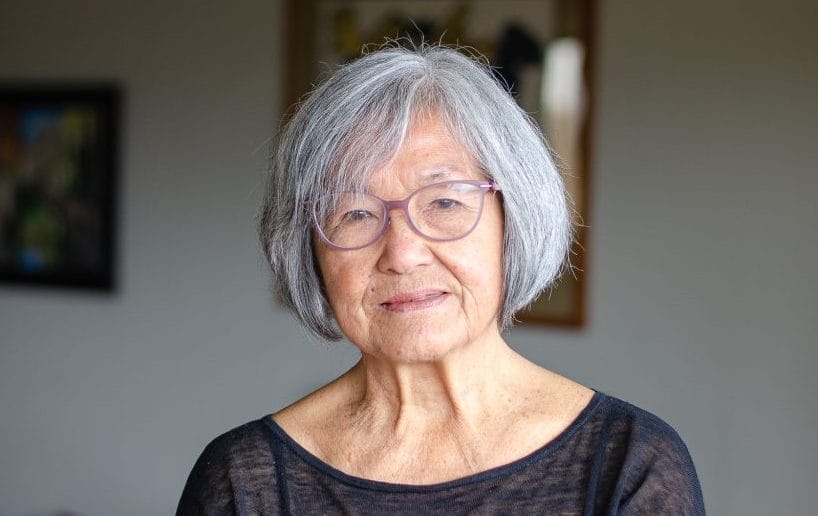
Nellie Wong is a poet and activist living in San Francisco. She is the author of five collections of poetry that span from 1977 with the publication of Dreams of Harrison Railroad Park to her most recent collection, Nothing Like Freedom (2024). Wong co-founded and organized several feminist literary collectives, including Unbound Feet (with Kitty Tsui, Merle Woo, Nancy Hom, Genny Lim, and Canyon Sam) and The Last Hoisan Poets (with Genny Lim and Flo Oy Wong). A socialist and a feminist, Wong is also a longtime member of revolutionary socialist organizations, Radical Women and the Freedom Socialist Party.
I first learned about Nellie Wong at a poetry event in 2019, when, during a Q&A, an older poet lamented how no one seemed to know Nellie’s work. A poet from an earlier generation, Nellie seemed to be at risk of being forgotten, as Asian American poetry becameomes an increasingly prestigious and acclaimed body of work in the 21st century.
I was one of those uninitiated, so I began to do some research: I bought a used copy of The Death of Long Steam Lady, ordered a DVD of Mitsuye & Nellie, Asian American Poets, and learned what I could about her life as a poet, an organizer, a feminist, and a secretary. All of these roles—poet, feminist, worker—came together in what I would describe as a poetry of lifelong commitment: to living a Third World, feminist, and socialist life, and to writing a form of poetry brought all these identities together.
I met Nellie in January 2023, where she generously invited me into her San Francisco home for an interview. Over hot tea, I spoke with Nellie about how she became a poet and an activist. A few months later, over Zoom, I spoke with Nellie again to continue our conversation about her political development through her involvement with socialist feminist organizations. We also talked about her close comradeship with other Asian American poets-activists like Kitty Tsui and Merle Woo, and her 1983 trip to China with Tillie Olsen.
Tell me how you got into writing poetry. What drew you into poetry in the first place?
I was working already. I'd been a secretary, an administrative assistant, and an affirmative action analyst when I was working. I went to San Francisco State in the early 1970s, after I’d already worked many years. What got me to go to college finally were a couple of things. My younger sister, Flo [Oy Wong], an artist and poet, said that I should take up writing. I asked, “Why”? She said, “Because you’re kind of funny.” [laughs] “Your newsletters are really funny. You should take up writing.” In those days, we didn’t have computers or phones, so I would write to my siblings to tell them to bring this or that for Thanksgiving or Chinese New Years.
Flo also said, “you also watch too much TV. You should get off your butt.” [chuckles] “Okay,” I thought, “Maybe I will do that.”
I signed up for a class at Oakland Adult Evening School. It was on short story writing. The teacher liked what I did, and every week I would raise my hand, I would have something to say, and I was writing. One of the first things I wrote was about my father. I think I wrote it as a parable. At that time, I didn't even know what a parable was. [chuckles] Each week I would write and turn in something. The other students were all adults, and it was only five blocks from where I lived in Oakland.
I was also working at Bethlehem Steel at the time. At work, there was an educational assistance program. The education assistance program was there to help us to do our jobs better at Bethlehem Steel. So I signed up, and my supervisor okayed all the courses I signed up for. I signed up for Asian American Studies. I signed up for Feminist Studies. I signed up for Creative Writing and English Literature. Here I was, already in my early 30s, and the classes that I took, I could only take at night because I worked full-time. That's what got me started.
I also signed up for a poetry class. I was very naïve, and I thought, "I'm interested in what poetry is. I don't know anything about it. So I'm going to sign up for this class.” But then, I found out it wasn't to study other poets. It was to write poetry. I was too scared at that time to drop out, because I’d worked so long to get to college. On the first day, the professor said, “People with last names between A and D are going to read next week.” I said, “Read? Read what?” [laughs]. We were supposed to read our own writing! I’d never written anything.
So I wrote. I was married at that point, and living in an apartment in San Francisco. I told my then-husband, "Leave me alone. I'm going to write a poem." [laughs] That's how I got started. I wrote some poems, and I took one to class the following week. My married name was Balch, B-A-L-C-H, so I was one of the first student poets to read. I read one on Miss Chinatown, USA. It’s called “Drums, Gongs.” It was in my first book, and eventually published in East/West [Chinese American Journal], an English language newspaper that came out of SF Chinatown.
After I read, the teacher said, “Once you've written angry poems, you should throw them away.” I was just mortified. I wasn't speaking up in those days. I told some other students in my feminist studies classes, and they said, "You don't have to listen to him.” I was just shocked. "What? He's the professor!" Eventually, I showed them my poetry, and then I joined their group at SF State and started getting active and fighting for the inclusion of women and people of color in creative writing and other classes at SF State. I got active, and I joined the creative writing caucus. That's how I got started. I'm glad I mentioned it to my fellow students in the feminist studies classes. A couple of them were social feminists, and that's also how I met the Freedom Socialist Party and Radical Women at that time.
Your work at Bethlehem Steel, of course, makes it into your poetry. Tell me about how those things came together.
It started with my late friend and comrade, Karen [Brodine]. She's one of the women I met in my feminist studies classes. We did a workshop in the creative writing caucus, and she said to me, “You have to write about work.” I asked, “Why? I'm only a secretary.” "Nellie,” she insisted, “You have to write about work." That started it.
I found I had a lot of stories, and the poems started to come out, poems I didn't know were there. I think some of my best pieces are related to my life as a worker, as a woman worker, and being Chinese and a woman of color. Because there was so much racism and sexism that I encountered throughout my whole working life. What was really exciting is that there were all these possibilities opening up for becoming a writer, becoming a poet, that I didn't know [were available to me].
And then how did you get involved with Radical Women and the Freedom Socialist Party?
Well, that was Karen [Brodine] and another person, Sukey [Wolf]—they were in my feminist studies courses. We got to know each other through the creative writing caucus, and we had started organizing. They were recruiting me, but I didn't know that at the time. I started reading Marx and Engels, and I was invited to go to a meeting that the Freedom Socialist Party and Radical Women, their sister organization, were organizing. On the agenda, I remember, was the subject of divorce. I thought, "What in the hell does that have to do with the left and politics, and such?" That really got me going, thinking about it. Because I was divorced-- no, I wasn't yet, I was still married.
That was really kind of a kick in the butt to me, and I started understanding and reading more. The reading, the writing, and the activism all started to come together where again, my consciousness—I realized I didn't know a lot of stuff. That is how that all came about, and I began to look at my life as a working person. A lot of what I wrote, I wasn't really aware of what was coming out. I just wrote what I was going through. Do you know my poem, “Toss Up”?
You call meinto the hall. Standard procedurefor a conference.
You ask me:
if we had a fight, whose side would you be on?
His because he is Chinese, or mine because I am a woman?
That came from an actual experience with a supervisor who said that to me. Of course, that's one poem that I’ve memorized because it's short enough.
Actually, it was several years before I decided that that's what I wanted to do: to be an activist. All the ideas of socialism, Marxism, and the ideas of feminism—all those were a part of entering my body and my brain. That's what happened.
The topic [of the meeting] also had focused on the late Clara Fraser. She started the Freedom Socialist Party along with some others, when the party broke away from the Socialist Workers Party. Some of the issues were on feminism, on China, on the woman question, as we talk about it in socialist politics. That became a real draw for me and really excited me. I thought, “Maybe I shouldn't just be writing about family, being Chinese American, and being a working woman, et cetera.” That all started to enter into my life with what I wanted to do as a writer. Although I still have never really said, "Oh, you're a writer. You're a poet.” I always think about, "If I say all those things, then there would be too many expectations for me to fulfill those ideas or positions." That's when I began.
When I joined the Freedom Social Party, I was just really thinking about how I could contribute to making change, and what kind of a society we live in when we have racism, sexism, and class oppression. It all started to gel for me as a place where I wanted to be and where I wanted to work.
Now, as an older or a more mature person, [chuckles] hopefully, there was more to poetry than just expressing myself. There was a connection to other people of color, to women, to family, whether chosen or not. Those kinds of issues all came up for me. I would say that was what really kicked everything off. Then, of course, my husband was very angry that I was becoming radicalized and socialized, though he appreciated my publishing and getting a few poems out.
What were some things you were reading or encountering at that time that motivated you to embrace socialism and feminism?
It was really looking at the conditions of women. Radical Women is an organization that still exists and is a sister organization of the FSP. Reading The Radical Women Manifesto was very instrumental in helping me to think more and to understand historical materialism. I began to learn how these concepts connected to my own life, the life of my communities from which I have come.
Since I was a feminist, I thought I was unusual, because in the classes at SF State, there weren’t a lot of people of color or women of color. I got very excited when an instructor in Women's Studies introduced a new anthology that came out that had the writings of women of color. Many of them were radical women of color, some of them were lesbian. But there was all this social and political context in their works.
I was very excited and at that time, I still saw myself as a beginning poet and writer. But I still thought, "How come I'm not in that book?" [laughs] I just didn't know why that seemed really important to me, but I also was looking for stories, poetry, and essays on people of color, women, and feminism.
When I began to read a lot of these books and booklets on feminism and socialism, it really began to make sense to me. I'm just not living and growing up as a personal person. [chuckles] I began to develop an understanding of dialectical materialism and how it relates to me and what I was doing. I began to understand all these wars, like what World War II was about, or what happened in the Vietnam War, which got me thinking about the social and political aspects of life that were connected to the personal. Why did I always think that my life was my life, and if something didn't happen, it was my fault? Or if something did happen, I'm somehow responsible? I wasn’t understanding those connections, living as a human being.
One of my experiences as I was beginning to learn through books and activism—there was a bookstore in San Francisco's Chinatown or Manilatown area. I think it was called China Books. I was so curious, I used to go in there and start looking at books. I started talking with one of the owners, and I was interested in what happened with China, because my parents were from China. The China they came from was a small village in Guangzhou or in Canton. I was totally curious and interested, so I began to go to that store and pick up some books.
At that time, I didn't understand what Maoism was, I didn't understand Trotskyism or Stalinism. Freedom Socialist Party also had a lot of documents and books and publications that I began to read and absorb. But I think the key was feminism. That drew me to the Freedom Socialist Party and Radical Women. We were all women who are a little bit older. Not in their late teens or early 20s, but in their 30s and 40s and up. That was something that drew us together, as well as ethnic studies, or women's studies, or LGBTQ [issues] and labor and such.
I already mentioned that Karen encouraged me to write about work. That was another opening when I began to see. I didn't know what class was at all and so those were part of what I see as my stepping stones into joining and being active. I changed personally, and it was because of the political that I was able to read, understand, examine, analyze, and question everything.
You were most active with FSP in the '80s and '90s. Looking back at those years, a lot of people would characterize them as counter-revolutionary or reactionary times after the Civil Rights Movement. What were some of the struggles you and FSP faced?
For me, I love what we were able to do. It's not like everything is a victory, because it's not easy being a revolutionary feminist, let alone a revolutionary feminist of color. [chuckles] Not to mention being a little older. Because you're going against the current. If I keep on writing and if something gets produced or published, that's of course not the end-all be-all.
But I also see writing as activism. What kind of a country do we really have? Is this the kind of United States that we really want to build? I want to be a part of that change if I can. My work is related so much to seeing the possibilities of a changing world, that we need to build for a society that does not chase after profits or money for military and arms manufacturers.
The whole concept of leadership is a part of what we work on and think about. What is a leader and who is the leader? I can't explain it all in our interview, but leadership is a relationship. Leadership comes with what we think we can do, and the vision that we have for building a society that would eliminate so many of the things if money, profits, and domination weren’t a priority.
I've also been baited for being a red or sticking with the FSP. One time, a friend of mine told me, “Clara Fraser is a racist." I said, "What?" This friend of mine, she was a co-worker at the time, and I said, "You think I would join a movement or an organization that was racist?" She couldn't answer me, and I thought, "Now why would she think Clara was a racist?"
She obviously didn't know the work of Clara Fraser, who's a Jew, whose parents were socialists and union organizers. There are a lot of battles we have to fight, just because we're of the left. Other times when people say, "Oh, you shouldn't join that organization," or, “you should stay away from those women because of what they're doing." I would say, "you know what? I'm one of them."
Then the conversation doesn't go further, because of a lack of time or whatever the circumstances are. Or there's little respect you have of me, because I'm doing something different from what you're doing and what you're thinking. It's about being open, if you can be, to the ideas, to the vision, to the work, and to our global reality.
Even on the left, among socialist groups, we have a lot of differences. But as Trotskyists, we talk about the need for a united front, where we can join and work together. We can raise our own banners, but we have to understand that we share a goal of what we want this movement to be. What are our possibilities, when the neo-fascists come riding into town, or the anti-abortionists come into San Francisco every January? Usually, those who are protesting are small in numbers. There's also a larger question of how the left has to organize. So that's part of what I'm trying to do as a member and activist within the FSP.
I want to go through some of your friendships and collaborations with other Asian American poets as well. We can start with Merle Woo. How did you meet Merle?
Well, I was going to SF State at the time, and I was in a class. Then I had a friend in the class who was taking Merle's class. She was teaching at SF State, and I didn't know her. Because I was only going to school at night, I said, "Oh, I can't take it.” But she was doing a class on Asian American women. I said to my friend Mimi, "Why don't you find out from Merle Woo if I could talk with her or meet her? Because I can't take the class."
Well, then she brought back a tiny piece of paper, and it had Merle's phone number on it. I called her, and that's what started our friendship and we started collaborating a lot. Then I was in the Women's Caucus in Creative Writing at that time, which became the Women Writers Union at SF State. I introduced her to the caucus, and she met Karen and we all started to do stuff together.
The first time I met Merle was at a reading for my first book. It was Dreams in Harrison Railroad Park. She came with a fellow teacher of hers. I think she also brought her son, Paul, who was only 11. Anyway, we met and that's when I met her. That's how we started our friendship. Then I introduced her to what became the Women Writers’ Union, and she joined it.
We were two women of color, two Asian American women that were the only—No, there was a Black woman. There was a Black woman also involved, but all the other women were white. Many were lesbians, and Merle is a lesbian. It was just fascinating, the encouragement and the push came from women who were radical and women who were gay.
You've also collaborated a lot with Mitsuye Yamada.
Have you seen the film, Mitsuye and Nellie, Asian American Poets?
Yes, I have.
Oh, good. I'm glad you saw it. That's also connected to SF State. Allie Light [the director] was a teacher. Allie is actually a neighbor of mine. She lives right here in Glen Park. She and her husband [Irving Saraf] were filmmakers. Allie was teaching a class called the Woman as Creative Agent. When I saw the class, I said, "I'm signing up for that." She and this other woman taught the class. That was one of the most exciting things I've ever gone through. We learned to write in dream journals and such…
Allie knew Mitsu. I didn't know Mitsu at that time. I had heard of her, but I didn't really know her. I knew what she had written, and I had gotten her book, Camp Notes. To cut to the chase, Allie talked to both Mitsu and me, and she said, "I'm going to make a film, and I want you guys to be in it." She knew us older Asian American women who were poets and who were feminists. What pushed her towards that was that there was a film festival going on in SF State, and there were films on Black women and white women, but none on Latinos or Latinx, nor on Asian American women. She evidently got the bug from that. I thought, "Okay, I'm going to be in a movie." [laughs]
She didn't really write a script, but she submitted an application for the National Endowment for the Arts. Even before she got the grant, she started filming us. I was living with my then-husband in Oakland in a Victorian that his grandfather built. She started filming me there. That's how the film got started. Then she got the grant, then we went to--which camp was it? Because of Mitsuye’s experiences from the concentration camp when the Japanese Americans were sent to the camps after the bombing of Pearl Harbor.
What do you remember about the very first time meeting Mitsuye?
Our filming experience together, and the fact that I really liked what she did in her writing—I think that there was that connection. She and her brother, Mike [Yasutake], in particular who was a priest—they were activists and supporting political prisoners, particularly the African American men who were imprisoned. I was getting another opening to what was going on with people of color, and that was all through Mitsu. You know, she's 99 now, I just received a Christmas note from her. We talk now and then, usually through email or a text, but we still have that connection. The filming really brought us together so much closer.
And how did you meet Kitty Tsui?
We formed Unbound Feet, which consisted of Kitty, Canyon Sam, Merle Woo, Nancy Hom, me, Genny Lim. I never knew who started it exactly, but I think we found each other through the community, the movements, and feminism was a strong part of that. We were together for about a year and a half, two years. It wasn't very long, from the late '70s to the early '80s.
What did you do together?
We wrote, and then we shared our writings. We didn't do workshops—well, maybe we did with each other. Then we said, “We have to read this to the community, we want to read our work.” Nancy Hom did this poster, and we did a performance. She's a great graphic artist, a community artist, so this is how we started. That's how I met Kitty and then I got to know Nancy, and that's when I really got to know Genny, Merle, and Canyon as well.
Do you know of a poet by the name of Stella Nanying Wong? She was a little older. She was very well known in the Chinese American community. When we started though, she wasn't a part of the group. We actually started with Stella, but we weren't Unbound Feet yet. We were just getting together to share our writings and to perform.
Most of us in Unbound Feet were either Cantonese-speaking or Taishanese-speaking. I’m part of the Last Hoisan Poets, with Genny and my sister Flo. Kitty is Cantonese, she's not Hoisan speaking. Her background is really fascinating. Her grandmother was an opera star. I think she even said that her grandmother was a lesbian, because they never really talked about it. That was just really fascinating. Anyways, that's how Kitty and I worked together for a couple years.
In 1983, you went on a trip to China, the US Women Writers Tour to China. It was right around the time where China was reopening again—
Yes, because China reopened after Nixon in the ‘70s. You want to hear about how I got into that? Sometimes it's just by chance and by luck.
I knew Tillie Olsen. I think she liked my writing and knew of me, although I didn't really know her well. One day, she called me up. I was already divorced then, and I was living alone. She called me and said, “Nellie, there's going to be a trip to China with the US-China Peoples Friendship Association, and there are no Asian American or Chinese American women on this trip. Can you come?”
The trip was in 1983, so in 1982, I was still working at Bethlehem Steel. However, we had already been notified that Bethlehem Steel was shutting down. I knew I would be out of a job at the end of December. When Tillie sent that, my first book was out, and that's all I had. I used my severance pay to finance my trip.
That's what happened there. I was delighted that Tillie called and asked me to go. I said, “Wow, I'll try to go to my father's village,” which I did. [laughs] By luck, I got to go to my dad's village in Guangzhou. It was in the Taishan area around the Pearl River Delta. Our village was the Taishan-speaking village.
What was that like for you, visiting your dad's village?
It was really exciting. We met members of the Chinese Communist Party. We discussed feminism. The writers' tour had maybe a dozen of us or so. I was the only Chinese American on the tour, but there was also an Indian American poet. The rest were white women, both gay and straight. It was mixed. Alice Walker was a part of that, so was Tillie. And I roomed with Tillie.
Tillie and I got to know each other more. Also, she had invited me one time to meet Ding Ling, the very, very prolific, well-known woman writer of China, a novelist. I was supposed to meet Ding Ling in San Francisco, when she visited the United States. But Tillie gave me the wrong date. [laughs] I didn't get to meet her. But on this trip, I got to meet her, finally!
Her translated writings inspired me, even though I’m US-born, just in learning more about the feminist women in the movements here and in academia who were publishing her stuff.
Today you're part of another poetry collective, the Last Hoisan Poets. How did that come about?
That got started, Joe, because we were writing using hoisan-wa in our poetry and other writings. Flo, Genny, and I were reading at the Chinese Historical Society one time a few years ago. However, I got sick and I couldn't go. Flo and Jenny did it, and they both didn't know that their poems had these Hoisan phrases. They clicked on that. Then another time, we were going to do a reading and then this time I wasn't sick. We came up with the name, Last Hoisan Poets. We're not the last, but we just thought it was a good thing to name ourselves.
We presented at different places, like the Chinese Historical Society and elsewhere, as well as a couple of events at the de Young Museum, where we did a tribute to Hung Liu. She was a well-known Chinese artist, and her background was just fascinating. She came to the United States in the ‘80s. She taught at Mills College, and her paintings are just monumental. She became very well known. Flo knew her and I met her, but Flo knew her well. Just recently, we also did a tribute to the African American artist, Faith Ringgold. We would write poems, especially around their lives and their art, and then we also then include Hoisan phrases.
I've written some poems entirely in Hoisan. I would write it, and I would sound it out phonetically. When I was younger, I thought, "Oh, we don't need to speak the dialect, we're Americans.” But I started to write at night, after I lost the jade heart my mother gave me when I was moving. I'm really mad for having lost that. My mother was already gone, so I decided to tell her [in writing], but what I told her came out in the Hoisan dialect, because that's what we spoke when we were kids.
What are you reading these days? Do you keep up with much contemporary poetry?
I don't buy every book that's come out, but I think I'm very, very interested in novels and other writings. I read a lot of poetry, but some of the poets that really stick with me have been people like Mahmoud Darwish, a Palestinian poet. I have about a dozen books of his that have been translated into English.
Well, some of the recent books I've read—I really love Min Jin Lee, Pachinko. I've read that two or three times. Did you watch the series on Apple?
No, I don't have Apple TV.
I thought they did a good job. I have read the book several times, and it doesn't do exactly what the book does. It never does, but it's well done.
There are some very well-known Korean actors in the series.
Yes. I'm also a nut on Korean drama. Taiwanese, too. I don't watch Japanese dramas so much, but I'm a huge fan and student of Japanese cinema. I love [Yasujirō] Ozu, [Mikio] Nakuse, and Kenji Mizoguchi. I love film and I watch a lot of international films, but I'm a huge fan of Korean and Chinese dramas.
Do you have any favorite dramas?
Well, Winter Begonia is one I just watched, and it's about the Peking Opera. Winter Begonia might be 40-something episodes. Winter Begonia is just terrific. There are others I like, but I think I'll take up too much time talking about it. [chuckles]
Well, those are all my questions. Nellie, thank you so much for your time today. It was wonderful being in conversation with you.
Joe Wei is an assistant professor of English at the University of Georgia. He's currently working on his first book, Asian American Literary Organizing, 1970s to the Present, which investigates the role of Asian American literary organizations—from Kearny Street Workshop to Kundiman—in realizing and sustaining models of literary production outside of mainstream literary institutions.