Keva Bui on Napalm and U.S. Empire
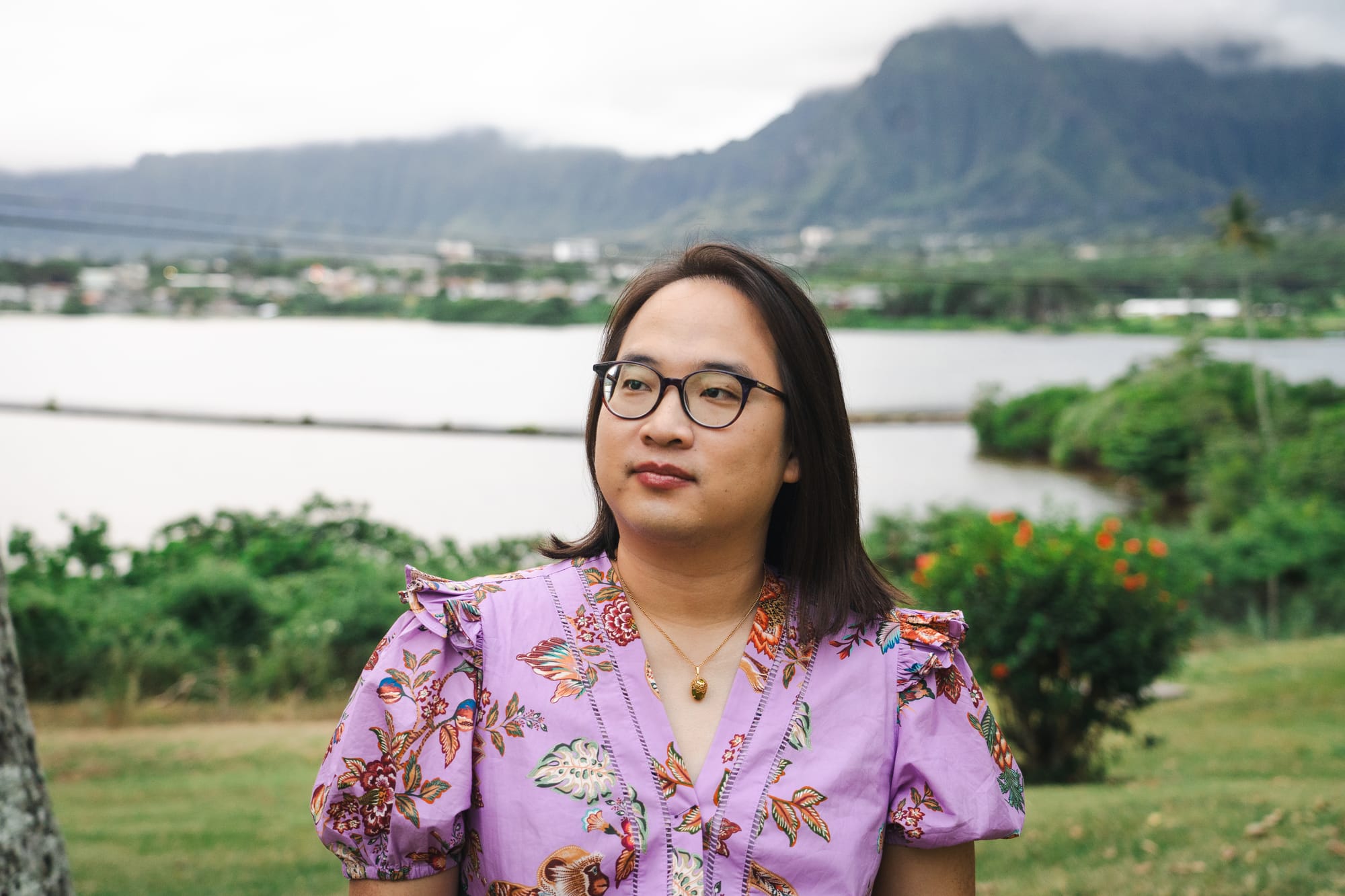
Keva X. Bui is an Assistant Professor of Asian American Studies and the Council for Race and Ethnic Studies at Northwestern University. They are a scholar of science, technology, war, and empire and hold a PhD in Ethnic Studies from the University of California, San Diego. Their research examines cultures of war in everyday life in the heart of U.S. empire, and how anti-war social movements offer visions of life beyond the stranglehold of the military-industrial complex. As a child of Vietnamese refugees who grew up in Taipei, Taiwan, their life has been touched by war on multiple registers. These intimate encounters with the US war machine guide both their scholarly research and political commitments to the work of demilitarization.
What about Asian American literature and culture inspires you?
When it comes to Asian American literature and culture, I’m inspired by its capacity for forging new worlds from conditions of violence and catastrophe and to reflect back onto the world that we live. As a scholar and researcher, I'm constantly stuck researching horrific violences—how war and empire have devastated communities, environments, and ultimately, people's lives. There's no singular Asian American literature or culture; it's not a monolithic category, but rather something that imagines and creates worlds—that is world-making and world-breaking. The central question that I think about is: How can we imagine better futures for ourselves and our communities?
I'm constantly inspired by how central art and culture was to the imagination of the Asian American anti-war movements of the 1960s and 1970s. A lot of poetry, a lot of political cartoons were circulated in radical newsletters during that moment that developed a very poignant critique of the military industrial complex. Those kinds of critiques offer us a pathway to organizing, to reflect on the world that we are trapped in and make use of narrative tools to unravel logics of violence. Literature and culture's capacity for shining a light on the world that we live in is so important to the work of demilitarization, and there's a lot of power in narrative to shape how we understand the world.
You said that you’re “constantly stuck” researching horrific violence—what makes this the case? Is there a link between that stuckness and the inspiration?
I think about that a lot, because I study weapons of mass destruction—things like napalm, herbicidal warfare, things that have caused horrific violence in our world. Obviously, it's not enjoyable work in a lot of ways, but I find it necessary; I do think we have to understand what led us to the violent conditions that we are mired within. How did we get here? How did weapons of mass destruction come to be normalized? There is a world before the military industrial complex—so how did this particular iteration of society become our norm? I think that's the tension between inspiration and stuckness that you're honing in on—that in order to be a scholar of demilitarization, to invest in anti-war social movements, I have to return to these violent moments to understand how they came to be. Reading the ways in which scientists and military commanders envisioned weapons—they envisioned this violence—sometimes it's so mundane how it's articulated in the archive, and it can be very jarring and painful to sit with those words and stories for long periods. But I also try to remind myself that it's in service of understanding the world, so we can build something better for our communities. To understand the anti-war movement means we have to understand the war machine that the anti-war movement opposed.
Was there an early moment that you became interested in these questions in particular?
I did my undergraduate training as an English major, and a lot of my early work was reading Asian American literature, particularly Vietnamese American literature. As the child of Vietnamese refugees, my entryway into Asian American studies was through personal and family experiences, thinking about, how did the Vietnam War affect my family's life and my own life? How is that structurally connected to a larger system of the U.S. empire?
And that led me to a specific interest in napalm; in Vietnamese American literature, napalm is a motif, a symbol, an idea that is constantly returned to. And oftentimes it would be this aside. It'd be mentioned. It would be a stand-in for something, a symbolic thing. For example, there was an interview that Ocean Vuong did with The Guardian where he talks about stories his grandmother would tell about the Vietnam War. He comments about how his grandmother would often mention napalm as an aside, such as “oh that came after the napalm,” but would never answer him when he would ask “what’s napalm?” I think there’s something significant about that exchange - napalm being omnipresent in these stories but lacking clear definition.
That interested me, so I began studying napalm’s history. The anti-war movement took up napalm as its iconic crime against humanity that the U.S. was committing in Vietnam. The infamous "napalm girl" photo that circulated in 1973 of Phan Thị Kim Phúc, for instance, catalyzed a lot of anti-war sentiments. But I also learned that napalm was developed during World War II and used in the Pacific Wars. It predates the atomic bomb. It was used in the Korean War. It was used in Israel's Six-Day War in 1967. For me, that posed a tension, in that napalm became this quintessential U.S. weapon used in Vietnam, but it stretches across all of these other histories of U.S. military intervention.
And so what makes it exceptional in the Vietnam War and normalized in other wars? Weapons are not just neutral objects, but themselves are bearers of political and cultural significance that shape the world that we live in. The tension between its symbolism and its material history is what sparked a lot of my interest in how cultural narratives around weapons of mass destruction are constructed, and then the work they do in consolidating the military industrial complex that we live in.
And what was your scholarly journey like, through Asian American Studies?
I was an English major at Dartmouth College, and then did my PhD in Ethnic Studies at UC San Diego. I learned about Asian American Studies when I was at Dartmouth in rural New Hampshire, an “elite” Ivy League university, very white, very isolated. There I met a group of Asian American activists who were organizing on campus to establish an Asian American Studies program. That's how I began my venture into the field. I took the very few Asian American studies classes that were offered on campus by professors who are no longer there. But it provided a moment for me to think about the political stakes of Asian American Studies as a scholarly field. It demonstrated how Asian American studies was something we as students had to fight for. It was knowledge and an intellectual community that we had to fight for. That's what granted it a lot of meaning for me, is how we had to fight for the space to even learn about Asian American history, Asian American culture, Asian American politics, Asian American social movements. Students of Asian American studies know that the field has a long history of student organizing, that it emerges from the Third World Liberation Front, the student strikes in 1968 at San Francisco State University and UC Berkeley that really established the field of Asian American studies and ethnic studies. I think that being in a place where it was something we had to fight for really was both a challenge but gave it, for me, higher stakes. And so I went on to do my PhD in ethnic studies and deepen my understanding. And so, living in San Diego, which is both a refugee city and a militarized city, it's very close to one of the largest military bases in the U.S., Camp Pendleton, and it houses a large refugee community of Southeast and also Southwest Asian refugees. Being at the Pacific borderland, as well as the U.S.-Mexico borderlands, creates this acute sense of living in a militarized city. Living there, doing a PhD in ethnic studies, really granted me a space of interrogating how, as I've mentioned before, war and militarization invades everyday life, because it was all around me. And at the same time, I began organizing with Vietnamese American communities in Southern California, with Viet Unity Southern California, the Hai Ba Trung School for organizing, and the Missing Piece project which is an artist-activist collective, and those organizations were important to my political development, especially how I think about the enduring impact of war on people's lives long after war “ends.” My scholarly study is informed by how I moved throughout society, and these political organizations; at the end of the day, I'm trying to understand how war invades our collective everyday life, and invades my own personal everyday life, how I constantly see war everywhere I move through the world.
In 2021, you wrote the article, “Objects of Warfare,” and then in 2022, “More Than Human,” then in 2023, “Eugenic Ecologies,” in 2024, “Napalm University,” and this year “Incendiary War,” a talk I heard you deliver at the AAAS conference. All are related to this subject; it seems to me that you've really allowed napalm to guide you in this very beautiful, ecological way. For you, napalm is coming out of diasporic Vietnamese cultural production in particular, yet also, when you spoke of napalm and white phosphorous at the conference this year, where people were grappling with the ongoing genocide of Palestinians alongside it being 50 years since the fall of Saigon, you seemed to be proposing a way for the materialities and symbols of empire to map this more expansive solidarity, wherein napalm was figured as a “sibling technology” alongside others. That was initially why your work stood out so much to me—how can we think through this ecology? What does it mean to draw this filial connection between technologies of genocide and war?
Thank you so much. That question really gets to the heart of what I'm trying to think about. This past year, we've seen Vietnamese American communities really grapple with how the anniversary occasions a moment to think about solidarity. But the tension is that the anniversaries connote an end that we have to commemorate as other violence is ongoing. What my research tries to articulate is that violence is not only ongoing, but it's recursive. There is this ongoing Nakba, almost two years since the most recent Israel bombardment of Gaza began, but a genocidal campaign that's been ongoing for decades since 1948. In 2012, the Human Rights Watch published an article about white phosphorus, and they declared it the “new napalm,” based on the U.S. usage of white phosphorus in Afghanistan, as well as Israel's usage in Gaza in 2009 as part of Operation Cast Lead. This is notable because white phosphorus was invented prior to napalm, during World War I, and was used as an incendiary device in wars ensuing after. Once napalm was invented, white phosphorus was used as an ignition substance within napalm bombs - napalm is a gelled petrochemical that can burn hot and stay hot, but needed white phosphorus to provide the initial spark. White phosphorus is a pyrophoric substance, meaning it catches fire upon contact with oxygen. So napalm and white phosphorus have always been used together. But what happens after the Vietnam War, is that because of napalm's iconography, napalm and other incendiary weapons were banned by the United Nations Convention on Certain Conventional Weapons treaty in 1980. White phosphorus is mostly unmentioned because it doesn't rise to the same cultural significance in terms of its iconography, so it goes unbanned. Then, it is continually used in the U.S. and Israel's wars in the years after. So my question about this sequence of events then is: what happens when we exceptionalize a weapon like napalm as exceptionally inhumane in comparison to other weapons of mass destruction? We risk inadvertently normalizing other technologies of violence, rather than saying, actually this entire structure of the military industrial complex needs to be abolished.
In this moment of the 50th anniversary, one of the things often unremarked about the radical anti-imperial, anti-war movements of the 1960s is that activists were making the claim that the U.S. was committing genocide in Vietnam. We're in a moment where there is a lot of debate over the term genocide. Who gets to claim the term genocide? But actually, the exceptionalization of the term obscures the ongoing structural conditions of violence that imperial nation-states continue to wage on colonized peoples. I draw a lot of inspiration from the 1951 Black Civil Rights Congress petition to the United Nations, “We Charge Genocide,” where a group of Black activists, three years after the UN Genocide Convention, which established the terms of genocide after the Holocaust, charged the U.S. with committing an ongoing genocide of Black Americans, dating through slavery, Jim Crow laws, lynchings, and all of these other forms of structural elimination. What this moment exposes is that if we allow genocide to be taken up at its full definition, then the U.S. would be culpable for all of these other imperial violences, from its ongoing structural racism against Black communities to its military interventions in Korea, in Vietnam, later in Iraq and Afghanistan, as well as its support of Israel's genocide in Gaza and Palestine more broadly. These are questions to think about. Not to say it is or isn't genocide, but that the language offers a framework for understanding why the exceptionalization of the term obscures our capacity to understand how violence is connected in these expansive ways—not only in a way of analogy, like that Israel's genocide in Gaza is similar to the U.S.'s military intervention in Vietnam, but actually with material connections in the technologies that are created, used, and exchanged, and the ways in which those technologies enable new innovations across these joint military-industrial complexes to thrive. The severing of our capacity to recognize and map those connections across different moments of violence, is what leads us to think of war as an event rather than a structure, a one-time thing rather than a continuous structure of violence that we are living in.
That has to do with where you began—with forging new worlds, right? In and against the continuous violence of the world we live in now? How can we understand the structure of the current world?
Yeah. The world we live in is one of constant and permanent normalized war. People have this idea that war is a natural condition of human life, and I fundamentally disagree. War is manufactured, especially the way in which we articulate war in our current age. Contemporary war is completely different from pre-modern war, where you have clearly defined nations with clearly defined militaries engaging in combat on a battlefield. Now, war is very deeply seeped in everyday life. It's in our institutions. It's in our universities. It’s in our homes. It’s in our businesses, industries, corporations. People don't think of corporations like Google as a defense contractor, or a war company, but as recent campaigns like No Tech for Apartheid have demonstrated, Google has extensive contracts with the Israeli defense forces. And this is something that partially emerges in the aftermath of World War II, in the aftermath of the atomic bombings of Hiroshima and Nagasaki, where U.S. politicians and scientists were able to point to the “success” of the atomic bomb, of the Manhattan Project, as this collaboration between the military, the government, and scientists, and say, this is good for national security. And they consolidated that as the way in which we live. That's why we have the ballooning of defense contracts for the military and government funding for U.S. universities to conduct research that, whether directly or implicitly, aids the U.S. war machine. That's part of how the U.S. university expands in the post-World War II moment.
So I think about this often—how do I reconcile my place in the academy with the immense entanglement that the university has with the military industrial complex? But at the same time, as I write about in my article in “Napalm’s University,” the university has also been a really important site of the anti-war movement, where students have been able to find intellectual, political community that radicalizes them into these kinds of organized anti-war movements. The 1960s was this early moment of both, and the sit-ins, encampments, and protests are reemerging in our current moment, as that relationship between the university and the military has only deepened. People get the sense that this is how it's always been, and therefore will always be, but if we understand that there is a history to this, that gives us a pathway to imagine otherwise, and to understand that this isn't a normal condition of intellectual life at the university, nor a normal condition of life. It can be contested. It can be abolished.
One of the differences between contemporary and pre-modern war is the invention and use of the weapons of mass destruction that you research—not only napalm and tear gas, but also herbicidal weapons like Agent Orange. Alongside the “genocidal,” I keep returning to “herbicidal” as a category that gestures towards the eradication, as you wrote, of an “ecologically-porous definition of enemy life”—the exceptionalism you discussed is also deployed in terms of the human, so I’m curious if you could tell us more about how the U.S. war machine involves and affects not just people, but plant matter, land and ecology.
Definitely. When I write about herbicidal warfare, I'm particularly thinking about the history of Agent Orange, which is a chemical defoliant that was used in the Vietnam War to eliminate mangrove cover as well as cropland in rural and jungle areas of Vietnam. So part of the idea behind the chemical defoliant is that it could remove the plant cover that guerrilla fighters were supposedly hiding beneath and would become visible to U.S. fighter jets flying above. It was the idea that if you can remove the ecological life that the insurgents were embedded in, you could better fight the war. So war became a battle over control of land and terrain.
Arthur Galston, who was a plant biologist, coined the term “ecocide” to refer to the destruction of the environment as part of military intervention. One thing we sometimes talk about is that the U.S. military is the number one polluter in the world, and the number one contributor to carbon emissions through ecocidal campaigns like in Vietnam, as well as the emissions produced by millions of fighter jets, hundreds of military bases. So it's important to put that ecological devastation alongside the obvious human devastation of it. What is happening in the shift from pre-modern war to the modern military industrial complex, is that all of society, technology, infrastructure, and resources are geared towards the inevitability of war and extracted from communities. The increasing cost of health care, housing, education, child care, the lack of resources for communities of color, low-income communities, those are all structural because they are resources taken from those communities to funnel into the war machine. War is ending our world in many ways, in terms of how it conditions us to think, and how it is ending human life, and how it is shortening the lifespan of our planet through ecocidal campaigns of violence and the destruction of our environment, and these are all entangled in terms of how the military industrial complex has this cascading effect on more-than human life across the globe that we will feel for generations to come.
You earlier mentioned the photograph of Phan Thị Kim Phúc, but in addition to images, you also write about novels and performance. Do you see these forms working differently in relation to fighting imperial violence? Perhaps emerging more prominently from your work is a sense of the solidarity and insights of a coalition of artists across different mediums intervening in the world as is and forging new worlds.
It’s a big question that I'm still grappling with, because I think there's something intangible about what inspires us about art and culture. You know, sometimes we are moved by a particular piece, and only years later do we really identify why. Sometimes it's immediate. Sometimes we're like, oh, I know why. But I think that for me, part of it is its capacity to intervene into the world and make other stories visible and possible. A film that I watched recently that left a deep impact on me was “We Were the Scenery” produced and directed by Cathy Linh Che, Jess X. Snow, and Christopher Radcliffe. The film is about Cathy's parents, who were part of a group of Vietnamese refugees in a refugee camp in the Philippines recruited to be extras on the film “Apocalypse Now,” which is a very infamous, iconic Vietnam War film. The film centers on their experiences as background extras in the infamous napalm scene in “Apocalypse Now,” where a fleet of U.S. fighter jets drop tons of napalm bombs during the war in the backdrop, and in the foreground a colonel proclaims, “I love the smell of napalm in the morning.” This very militarized and masculinist portrayal of fascination with the violence of napalm has become an iconic and infamous depiction of the war. But “We Were the Scenery” uses that moment as a way to center the background actors and their experiences of how they made life in the refugee camps. What the film does is it takes this iconic moment of violence and turns it around to tell another story about it, that is hidden beneath, that is literally lurking in the blurred background of this soldier speaking about his fantasies of violence. What is in the background is people's stories of refuge that allows us to think, what lurks in the background of political and military violence? How can we use those stories to propel us to think about these larger questions about Vietnamese refugee communities, the military industrial complex, and the way in which military propaganda shapes how people orient themselves to war? It allows us to start asking questions about what we take for granted in the world. And in asking those questions, it gives us space to imagine other kinds of ways of being.
Do you think, when it comes to narratives told about Asian American history or in Asian American Studies, war and the military-industrial complex are too often also lurking in the background?
I don’t think that’s the case, actually. I think Asian American studies has been an important field for engaging counternarratives to war and militarism - both with its inception in the anti-war movements of the 1960s as well as really brilliant contemporary scholarship. My work would not be possible without this work coming to be—I am really inspired by the work that Asian American Studies and more broadly, Ethnic Studies scholars have been doing to ask critical questions about the military industrial complex and the war society that we live in. From scholars of the Cold War and Vietnam War to people critically analyzing the contemporary war on terror, anti-war scholars across the field are making really important connections that we need to grapple with. Anti-war scholarship is integral to the work that we're doing and how it can align itself with anti-war movements, both past and present. How do these visions for a world without war drive the kind of scholarship that we do? That driving impetus is important. I do think that we’re moving in a direction that will continually grapple with the multidimensionality of war. That’s what I'm really grateful to see, that we're grappling with the multidimensionality of war.
Who are the scholars who inspire you in this respect?
There’s far too many to name, because there are so many great anti-militarist scholars out there doing incredible work. Jodi Kim’s book Ends of Empire, published in 2010, was an important moment in the field for giving us a framework for understanding the Cold War as a structure, not an event. It helped establish a vocabulary for analyzing Asian American cultural production in the aftermath of the Cold War as a vector for understanding the racializing dimension of the war, and I think that opened up a lot of different modes of inquiry for understanding war in our everyday lives. Asian Americanist scholarship on war and militarism is extremely rich, and I’ve learned so much from the work of Simeon Man, Christine Hong, Yen Le Espiritu, Thuy Linh Nguyen Tu, and so many more.
I have also learned a lot from my former colleagues at the University of Illinois - Junaid Rana, Mimi Thi Nguyen, Rachel Kuo, and Maryam Kashani who have all really helped me situate a lot of this scholarship on war and militarism within our present conditions of ongoing genocide and violence. And I also have a lot of collaborators and co-thinkers around the intersections of war, science, and technology whom I’m constantly learning from, scholars like Natalia Duong, Aimee Bahng, and Heidi Amin-Hong. And finally, I’d also like to give a quick mention to the Mundane Militarisms collective, which emerged out of one of Sunny Xiang’s graduate student seminars at Yale University. I use this resource all the time in teaching, to show students how war lurks in the background of our everyday life so seamlessly and invisibly. This model of scholarly inquiry is so important in our day and age, as we try to make connections that are not always otherwise apparent.
Your attention to inquiry as a mode, even unconscious mode, is really striking in your work. For instance, you wrote about the deep imperial logic embedded in the asking of this question, “How can we make war more humane?” I’m curious, what better questions can we dwell with? Is it, how can we demilitarize? How can we forge new worlds?
Yeah, that question is one, as I write, that imperial militaries and nation-states like to proffer—how can we make war more humane, how can we innovate more precise technologies? Currently, we see the increasing usage of AI targeting in military campaigns to “lessen” collateral damage, and so technology is proffered as offering the potential to make war more humane by “only” eliminating “terrorists” and leaving “civilians” unharmed. But these are all constructed categories, and how they are defined and employed is very much deeply racialized in our current moment of the war on terror. And it also explicitly and implicitly ignores the very stark reality that war, in requiring the elimination of human life, is by nature inhumane. And if we move from that premise, then the question of how to make war more humane becomes obsolete precisely within asymmetrical conditions of imperial warfare and the structural conditions of racism that lead to it in the first place. The question more broadly we could ask is, how do we make society more humane?
And that would necessitate the elimination of war altogether, the absolute abolition of the military industrial complex that exists to maintain a particular status quo of imperial power, and the prioritizing of human life, environmental life, ecological life, planetary life, and the relations that sustain us.
I’m also wondering about the structure of war in relation to a word like “peace.” There’s this injunction often used against war consciousness, “keep the peace.” I want to understand what undergirds such a phrase, and “peace” in relation to other terms, “liberation,” “revolution,” and “utopias” that may be impossible to fully imagine or define. What are the terms that sit together with, or are dialectically related to, the structure of war?
That's a good question, because I’ve always had conflicting feelings about the word “peace.” It is very much set up in this dichotomous relationship to war as an event - a singular moment in time. If we are not at war, then we are at peace. It is a language that was used in the post-World War II moment to say that times of peace are moments where all segments of society need to be preparing for war, for national security and future war. The sentiment is echoed in scientific advisor Vannevar Bush's document, “Science, The Endless Frontier.” This idea of peace is not necessarily the antithesis of war, but envisioned as a momentary pause, a ceasefire, in a perpetual condition of war. That's why peace can make me feel uneasy, because it is captured in a colonial imperial imaginary rather than an actual break, a break from the condition of a permanent world that we see as inevitable. That’s why I constantly return to the language of abolition and what abolition looks like. Of course, this is very much indebted to prison abolitionists who are imagining a world without police and prisons. Abolition gives us the language and framework to think about demilitarization more wholesale, that doesn't mean imperial nation-states putting down their arms and not fighting in a momentary pause from a permanent condition of violence. The end of war requires a radical reorganization of society, from the economy to industry to education, because society's resources are almost fully oriented towards continual and perpetual war.
Earlier, you said you see war everywhere you go, and I’m curious where you're calling in from, and where you grew up—in these places, how have you seen war in your daily life?
I’m calling in from Seattle right now, it's where my parents live, but not where I grew up. I was born in Texas, first in Houston, then Austin, and then when I was about 10, I moved to Taipei, Taiwan. There, I attended Taipei American School, an institution originally founded by missionaries on the island who sought an “American” education for their children and the children of US military personnel stationed in Taiwan during the Cold War after the Kuomintang political party fled there. Not a lot of people at the school acknowledge this history or think critically about it, but in my years after leaving high school I often think about what it means for my education to have been routed through a circuit of US militarism - how military occupation laid the foundation for “softer” forms of US influence on the island that persist to this day even in the absence of “formal” US occupation. How did war shape what my education came to be? How does war lurk in the background of my own life, and how is my schooling fundamentally a product of violent war and Indigenous dispossession? These seem like large questions, yet they are relevant to us no matter where we grow up or live - precisely because the US war machine lurks everywhere. And part of my work is trying to think more deeply about these conditions.
Our personal lives are very much inflected by war. My parents came to the U.S. as a result of U.S. military intervention in Vietnam. That is what led to their movement from Vietnam to Texas. And then it was my dad's job in the tech industry that relocated our family to Taipei, Taiwan. This is a perfect example of how two transnational circuits - one of militarized refuge and another of global capitalism - move people across the world but still connected to the web of U.S. empire. These histories of war and mobility have fundamentally shaped my life and also the different privileges I was able to hold, attending an international school somewhere like Taiwan and the kinds of experiences and education I received as a result. War and militarization create these kinds of cascading experiences in how they invade everyday life. War brings about our world in particular ways.
What about Chicago, where you live most of the year?
Chicago is—I mean, as everyone knows, a heavily policed city. The technologies of policing that are present in Chicago are very much militarized and about tracking the movement of certain populations—particularly for Black, Brown, and immigrant communities. At this very moment, we are witnessing ICE terrorizing our streets and invading our communities - this notion that “inner cities” are an important frontier of war is governing the regime of state violence against communities of color. So when we talk about war as a condition of our everyday life, it's not just about the battlefield, but it's the ways in which technologies of war and militarization are mobilized to police the movement of populations, as well as the increasing dimensions of immigration detention, the deployment of ICE, and the increasing ballooning budgets of ICE to identify the “enemy” and remove them from the country. At the end of the day, this is the prevailing racial logic of war: to identify an “enemy” for elimination. These practices are inherently violent and enabled by these increasing surveillance technologies that are products, particularly of the post-9-11 movement, of the Department of Homeland Security, and Immigration and Naturalization Services, the creation of ICE. We think these dimensions of society are normal, but are actually emergent in the post 9-11 moment of particularly acute Islamophobia and the policing of black and brown Muslim communities. It's war on the home front, as scholars of the war on terror constantly remind us. But Chicago is also a city with vibrant political movements, both historically and also in the present that have and continue to challenge this regime of oppression.
Seeing war everywhere, does that feel like a weighty experience? How do you hold and move with or through that?
It’s both weighty and I think we bear a responsibility to make it weighty, if that makes sense. War is so normalized in our everyday life, it lurks in the background in ways that most people don’t even notice its omnipresence. To make it weighty - to pause, reflect, comment, and challenge - is the work of untangling this constant presence that invisibly but indelibly shapes our movement through the world. And I think this is a crucial part of the work of demilitarization, to make visible what previously isn’t and to assert that war is not a normal condition of everyday life. And once that becomes our motivating thought, once that becomes our political compass, that gives us space to imagine something anew.
One thing I admire, during this interview, and in your writing, is the emphaticness of your sentences. I'm thinking of the way you closed “Incendiary War,” you said, “If napalm and white phosphorus are deemed exceptional, then that narrative only serves to inadvertently reaffirm a liberal narrative that there even exists an ethical, humane method for an imperialist nation state to wage asymmetrical wars against colonized others. I emphatically assert that there is not.” And then, rowdy applause throughout the conference hall. It feels like there's so much journey and substance behind or anteceding that emphaticness. It’s everything we’ve been talking about this past hour, but my last question is just—what is it like to arrive at this kind of emphatic sentence or emphatic voice? Where does it come from, how does one develop that kind of emphaticness?
My goal as a researcher and a scholar is to communicate my argument convincingly to an audience, and it always starts with the premise that it's emphatic, because my belief is emphatic. My belief in a world beyond war is emphatic. So I want to communicate that through with emphasis, a confidence in our ideas, but also not just confidence, a steadfast belief that this is possible, that a world without war is possible. The emphaticness that you are ascribing to my work is really a product that I want my work to offer a pathway into believing that something is possible. That is the first step to really envisioning these other worlds, is to actually believe it is possible to live in a world without war and then to find ways to bring that into being—through craft, through language that is about communicating the possibility to believe it is possible. That's one of the things that I strive to do in my writing, in my scholarship, is to leave no doubt that I do believe in this and that I believe that we can actually enact this world.
Winona Guo is a PhD student of Asian American literature at Columbia University, and author of Tell Me Who You Are (2019).